|
|
|
Dinosaur Extinction
Dinosaurs inhabited the earth for over 165 million years,
during the
Mesozoic Era.
Most dinosaur species lived and died out during this period, but
at the end of the Cretaceous period
(65 million years ago),
all remaining
types of dinosaurs
(with the exception of birds which
had already evolved, and are widely believed to be descended from dinosaurs)
died out.
At the same time many other creatures
(for example
Ammonites,
and Belemnites,
as well as
Pterosaurs,
and many large marine reptiles such as
Mosasaurs.
Plesiosaurs and
Pliosaurs)
also became extinct.
In fact,
all animals
weighing more than 55 pounds (25 kilograms) seem to have died out!
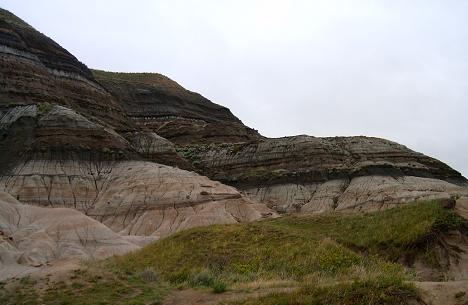
While are not sure what happened, we do know that something happened at about
65 million years ago. This
event shows up as clear boundary in the rocks, known as the "K-T boundary",
the extinction event usually being referrred to as the
"Cretaceous-Tertiary mass extinction".
Scientists have proposed many different possible explanations
for what may have happened, and
why this mass extinction might have happened:
(Note: Sometimes these suggested explanations are informally called "theories", however in this case
"hypotheses" is the correct term, since in science a theory
means a well-substantiated explanation of some natural phenomenon or observation,
whereas as "hypothesis" means a suggested explanation which needs
to be tested against experimental evidence).
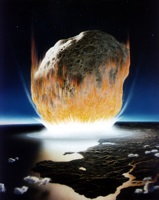
- Asteriod Impact Hypothesis
- Hypothesis: An asteriod hit the earth.
- Effect: Apart from the immediate impact of fires and flooding (if it hit the sea), this would have
caused catastrophic changes in the environment because of the dust thrown up in to the air blocking out sunlight.
- Our Evaluation: This is currently the most popular hypothesis with scientists, because,
as
Luis and Walter Alvarez
pointed out,
iridium (which comes from asteroids) has been found all over the world
in rocks at the K-T boundary (which were laid down at
the time of the mass extinction).
There is also a large
crater at Chixulub in southern Mexico,
which appears to be of the right age,
and could have been made as a result of an asteroid hitting the earth.
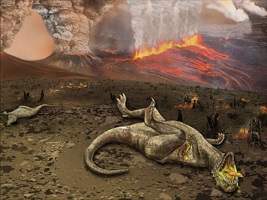
- Volcanism Hypothesis
- Hypothesis: Volcanoes (there is known to have been very active volcanic around this time, especially in
India in a region that is today known as the Deccan Traps) could have caused catastrophic changes in the environment.
- Effect: The dust from volcanoes would have affected the climate, sulphur from
volcanoes could have caused immensely strong acid rain, and poisonous
substances such as selenium could have been released into the atmosphere.
- Our Evaluation: After the Asteroid Impact Hypothesis,
this is probably the second most popular explanation among scientists - partly, because we know that
volcanoes were active at about this time.
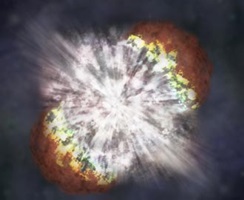
- Supernova Hypothesis
- Hypothesis: A nearby star exploded as a supernova.
- Effect: A nearby supernova would have bathed the earth in deadly radiation.
- Our Evaluation: If this hypothesis is true, rocks at the K-T boundary should contain 244Pu (a long-lived isotope of Plutonium). However, this does not seem to be the case.
- Climatic Change Hypothesis
- Hypothesis: Changes in the Earth's climate caused the mass extinction.
This could have been caused by gradual changes in the positions of continents
effecting ocean currents and winds, or by changes in the Earth's orbit around
the sun, or even by a relatively sudden greenhouse effects.
- Effect: Depends on the particular climate change theory in question.
- Our Evaluation: This hypothesis can not be discounted, and even if climate change was not
the main cause of the extinction, it could have played a part -
there is some evidence that the Earth cooled at the end of the
Cretaceous period.
- Flowers Drugged the Dinosaurs Hypothesis
- Hypothesis: The first flowering plants appeared during the
Cretaceous period,
and if dinosaurs ate them they could have been drugged by them.
- Effect: Could perhaps have wiped out some dinosaurs.
- Our Evaluation: This hypothesis does not explain the extinction of many other species, especially
marine species. It also struggles with the fact that dinosaurs and flowering
plants were contempories for many millions of years, and only suddenly, at
65 million years ago, the dinosaurs died out.
- Mammals Ate the Dinosaurs' Eggs Hypothesis
- Hypothesis: Mammals ate the dinosaurs' eggs.
- Effect: Could perhaps have wiped out some dinosaurs.
- Our Evaluation: This used to be a popular hypothesis -
but does not explain the extinction of many other species, especially
marine species. It also does not explain why dinosaurs were very successful
for millions and millions of years, during most of which time, mammals were also around.
- Caterpillars Ate All the Plants Hypothesis
- Hypothesis: Caterpillars ate all the plants and there was not enough food for
herbivores, and eventually not enough meat for carnivores.
- Effect: Could perhaps have wiped out some dinosaurs.
- Our Evaluation: This hypothesis
does not explain the extinction of marine species, and some may wonder whether
caterpillars could really affect every continent on the Earth at the same time
to this extent.
- Disease Epidemic Hypothesis
- Hypothesis: The dinosaurs could have been wiped out by a disease epidemic.
- Effect: Could perhaps have wiped out some dinosaurs.
- Our Evaluation: The
problem with this hypothesis, is could it effect dinosaurs to the extent of
wiping them all out, and how could it explain the simultaneous extinction of marine animals?
Although many scientists now favor the asteroid impact hypothesis,
it is not yet
actually certain that this is the reason why the
dinosaurs died out. It is possible that
one of the other theories might be the correct one. It is also possible, that
there could have been several events which happened together, and between
them, killed all the dinosaurs.
Related Information & Resources
See Also
Linking to This Page
We do hope that you find this site useful.
We welcome people linking to this website or citing us.
|
|
|