Facts about Mosasaurs, an extinct prehistoric animal
Welcome


Dinosaur Books
   Dinotopia
   Fiction
   Jurassic Park
   Kids
   Pop-Up Books
   Science
   Sticker Books
   Walking With Dinosaurs
   More Dinosaur Books


Dinosaur Calendars


Dinosaur Clothes


Dinosaur Crosswords


Dinosaur Facts
   Amazing Dinosaurs
   Classification
      Ornithischia
         Ankylosaurs
         Ceratopsians
         Marginocephalia
         Ornithopods
         Pachycephalosaurs
         Stegosaurs
      Saurischia
         Prosauropods
         Sauropods
         Theropods
   Definition
   Diet
   Eggs
   Extinction
   Family Tree
   Fossils
         Footprints
   Life Span
   Living Dinosaurs?
   Myths
   Timeline
      Triassic Period
      Jurassic Period
      Cretaceous Period
   World
      African Dinosaurs
      Antarctic Dinosaurs
      Asian Dinosaurs
      Australian Dinosaurs
      European Dinosaurs
      Indian Dinosaurs
      N. American Dinosaurs
      S. American Dinosaurs


Dinosaur Fun
   Action Figures
   Games
   Jigsaws
   Lego
   Lunchboxes
   Models
   Placemats
   Plush Toys
   More Dinosaur Fun


Dinosaur Games


Dinosaur Jokes


Dinosaur Museums
   UK Dinosaur Museums
   USA Dinosaur Museums
   More Dinosaur Museums


Dinosaur Names


Dinosaur Pictures


Dinosaur Posters


Dinosaur Scientists
   Charles Darwin
   Mary Anning
   Sir Richard Owen
   More Dinosaur Scientists


Dinosaur Software


Dinosaur Toys


Dinosaur Types
   Allosaurus
   Ankylosaurus
   Apatosaurus
   Baryonyx
   Brachiosaurus
   Centrosaurus
   Ceratosaurus
   Coelophysis
   Deinonychus
   Dilophosaurus
   Diplodocus
   Euoplocephalus
   Iguanodon
   Kentrosaurus
   Lambeosaurus
   Maiasaura
   Megalosaurus
   Microraptor
   Monoclonius
   Pachycephalosaurus
   Parasaurolophus
   Pentaceratops
   Protoceratops
   Saltopus
   Saurolophus
   Seismosaurus
   Spinosaurus
   Stegosaurus
   Styracosaurus
   Supersaurus
   Triceratops
   Tyrannosaurus Rex
   Velociraptor
   More Dinosaur Types


Dinosaur Video Games


Dinosaur Videos
   DVDs
      Jurassic Park
      Walking With Dinosaurs
   VHS Video


Dinosaur Word Search


Other Prehistoric Animals
   Aetosaurs
   Ambulocetus
   Ammonites
   Andrewsarchus
   Archaeopteryx
   Basilosaurus
   Belemnites
   Brontotheres
   Chalicotheres
   Champsosaurs
   Coelacanth
   Cynodonts
   Dicynodonts
   Dimetrodon
   Gastornis
   Glyptodonts
   Gorgonopsians
   Hesperornis
   Hyracotherium
   Ichthyosaurs
   Mammal-like Reptiles
   Mammoths
   Mastodons
   Megaloceros
   Megalodon
   Meganeura Monyi
   Megatherium
   Mosasaurs
   Moschops
   Pakicetus
   Paraceratherium
   Phorusrhacids
   Placoderms
   Plesiosaurs
   Pliosaurs
   Pterosaurs
   Sea Scorpions
   Smilodon
   Spiny Sharks
   Tiktaalik
   Titanoboa
   Trilobites
   More Prehistoric Animals


Dinosaur Links
   Dinosaur Hangman
   Dinosaurs News
   Dinosaurs Parks

Educational Products
(Advertisements)
   Make Math Fun!
   Super Science Projects
   24 Hour Science

Science Links
   Science Downloads
   Science eBooks


Dinosaur Jungle   >   Other Prehistoric Animals   >   Mosasaurs

Mosasaurs


Mosasaurus
Click here for more Mosasaur Pictures

Scientific Classification
  Kingdom Animalia
  Phylum Chordata
  Class Sauropsida
  Order Squamata
  Suborder Scleroglossa
  Infraorder Anguimorpha
  Family Mosasauridae
Mosasaurs are a group of extinct marine reptiles. They were powerful swimmers with long streamlined snake-like bodies (although they did have four limbs all finned, and possibly a finned tail), and ate fish, turtles, sea urchins, and shellfish including molluscs. The smallest known mosasaur was about 10 feet (3 meters) long, but the largest grew as long as 57 feet (17.5 meters).

Mosasaurs were not dinosaurs, but were lepidosaurs (reptiles with overlapping scales, the group that includes lizards, snakes, and sphenodonts such as the tuatara):
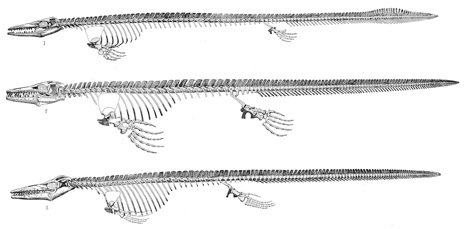
  • Mosasaurs are believed to have evolved from aigialosaurs, which were semi-aquatic lizards that lived during the early Cretaceous period, and who are believed to be related to monitor lizards.

  • In 1869, Edward D. Cope suggested that Mosasaurs and snakes share a common marine ancestor. This idea was based on the similarities observed in Mosasaur and snake jaws, the reduced limbs, and the fact that Mosasaurs may have moved in a similar way to snakes. In the 1990s, the discovery of fossils of early snakes with vestigial limbs in marine sediments seemed to provide support for this hypothesis. However, more recently, other early snake fossils have been found, and since these show animals with hind limbs and an apparently burrowing lifestyle, some doubt has been cast on the idea that Mosasaurs and snakes shared a common ancestor.
Fossil Mosasaur, Pachypleurosaurus Gezobitomenzone, Lower Triassic
Fossil Mosasaur, Pachypleurosaurus Gezobitomenzone, Lower Triassic Photographic Print
Dennis, David M.
Buy at AllPosters.com

Mosasaurs appear to have first evolved during early or middle Cretaceous period, perhaps around 96 million years ago. In the last 20 million years of the Cretaceous, following the extinction of Ichthyosaurs, they became the dominant predators. However, all Mosasaurs died out during the mass extinction at the end of the Cretaceous period.

The first publicized discovery of a Mosasaur fossil occurred in 1778. A fossil was found in a limestone quarry in 1780, near the city of Masstricht in Holland. It was not however named or scientifically described until later, the name eventually given, Mosasaur, means "Meuse lizard", and refers to the nearby Meuse River. Subsequently, other fossils which had been found earlier in the same area, and had been on display since around 1770, were also identified as being from a Mosasaur. Since then, other Mosasaur fossils have been found in many other countries around the world, including Australia, Canada, Denmark, Mexico, New Zealand, Peru, Sweden, and the United States, as well as in Africa and off the coast of Antarctica.

24 Hour Science Projects

Mosasaurs Timeline:


Mosasaurs were marine reptiles that lived between 96 and 65 million years ago

Mosasaurs were marine reptiles that lived between 96 and 65 million years ago

Making Math More Fun - Math Games Package

Related Information & Resources


See Also
24 Hour Science Projects


Mosasaur Pictures and Posters

by AllPosters

Here are some Mosasaur pictures and posters:

(Disclosure: Products details and descriptions provided by AllPosters. Our company may receive a payment if you purchase products from them after following a link from this website).

 
Fossil Mosasaur, Pachypleurosaurus Gezobitomenzone, Lower Triassic
16" X 12"
Photographic Print
Artist: David M. Dennis.
Fossil Mosasaur, Pachypleurosaurus Gezobitomenzone, Lower Triassic


Mosasaur Fossil (Keichousaurus Hui), Triassic Period, China
16" X 12"
Photographic Print
Artist: Ken Lucas.
Mosasaur Fossil (Keichousaurus Hui), Triassic Period, China


People Excavate the Spine of an Extinct Mosasaur on a Prairie Pasture
12" X 16"
Photographic Print
Artist: Jack Fletcher.
 
 
Fossil Mosasaur, Pachypleurosaurus Gezobitomenzone, Lower Triassic
21.6875" X 17.6875"
Framed Art Print
Artist: David M. Dennis.
 
 
Fossil Mosasaur, Pachypleurosaurus Gezobitomenzone, Lower Triassic
30.625" X 24.625"
Framed Art Print
Artist: David M. Dennis.
Fossil Mosasaur, Pachypleurosaurus Gezobitomenzone, Lower Triassic


Fossil Mosasaur, Pachypleurosaurus Gezobitomenzone, Lower Triassic
38.875" X 30.875"
Framed Art Print
Artist: David M. Dennis.
Fossil Mosasaur, Pachypleurosaurus Gezobitomenzone, Lower Triassic

 
Search For Posters!


Mosasaur Books


Here are some books from Amazon.com:

Disclosure: Products details and descriptions provided by Amazon.com. Our company may receive a payment if you purchase products from them after following a link from this website.

Mosasaur, the Return: Book Two of the Mosasaur Series
By David D. Holt

AuthorHouse
Paperback (352 pages)

Mosasaur, the Return: Book Two of the Mosasaur Series
List Price: $17.99*
Lowest New Price: $16.19*
Lowest Used Price: $17.99*
Usually ships in 24 hours*
*(As of 11:29 Pacific 2 Sep 2010 More Info)


Click Here
Product Description:
James King is back, in this sequel that pits man against beast-again. Flashback: the year is 1973 and the W.A.R facility has deposited highly toxic and radioactive waste on a secret base in central Florida. From the 1960's thru the 1980's, another top secret genetic research facility near Welaka releases hundreds of test subjects into the wild near the toxic dumping ground. Since 1973, strange wildlife attacks upon humans have taken place; but suddenly stopped in the year 1992 when the first live Mosasaur appeared through a large sink hole and after seven grueling days of death, that first Mosasaur was exterminated but not before leaving something behind-a brood of seven vicious hungry pups! Eight years have passed and no more attacks upon humans have taken place since that horrible week in 1992, and now only three of the Mosasaur brood remains as they forage for food. The food that they've consumed during the past eight years has been contaminated with toxic and radioactive residues, accelerating their growth rate. Then the attacks begin, first with two fishermen, then a party boat full of people and next three escaped prisoners; the number of dead continue to increase as Putnam County is once again locked down with the US Army, National Guard and countless Law Enforcement officers in a desperate search and destroy mission. John Jason Robards, the eccentric millionaire and fossil collector is back with a vengeance as he maneuvers his childhood friend the Governor into a plot to capture the killer Mosasaur, for Robards has secretly built a massive habitat to hold the vicious predator. Mr. Robards entices Dr. King into running the facility and thus giving Dr. King full access to the Mosasaur, but only if they can catch it in time before it's too late.
Mosasaurs: Mosasaur, List of Mosasaurs, Mosasaurus, Tylosaurus, Tylosaurinae, Plioplatecarpinae, Halisaurinae, Dallasaurus, Platecarpus
Books LLC
Paperback (144 pages)

Mosasaurs: Mosasaur, List of Mosasaurs, Mosasaurus, Tylosaurus, Tylosaurinae, Plioplatecarpinae, Halisaurinae, Dallasaurus, Platecarpus
List Price: $19.99*
Lowest New Price: $19.99*
Lowest Used Price: $21.70*
Usually ships in 24 hours*
*(As of 11:29 Pacific 2 Sep 2010 More Info)


Click Here
Product Description:
Purchase includes free access to book updates online and a free trial membership in the publisher's book club where you can select from more than a million books without charge. Chapters: Mosasaur, List of Mosasaurs, Mosasaurus, Tylosaurus, Tylosaurinae, Plioplatecarpinae, Halisaurinae, Dallasaurus, Platecarpus, Russellosaurus, Eonatator, Mosasaurinae, Globidens, Plotosaurus, Selmasaurus, Clidastes, Carinodens, Plioplatecarpus, Taniwhasaurus, Hainosaurus, Prognathodon, Liodon, Moanasaurus, Aigialosaurus, Halisaurus, Kourisodon, Igdamanosaurus, Plesiotylosaurus, Vallecillosaurus, Mosasauroidea, Tethysaurus, Yaguarasaurus, Eidolosaurus, Carsosaurus, Ectenosaurus, Komensaurus, Pontosaurus, Mesoleptos, Goronyosaurus, Angolasaurus, Pluridens, Haasiasaurus. Excerpt: Aigialosaurus Fossil range: Late Cretaceous item Synonyms item Opetiosaurus Kornhuber, 1901 Restoration of A. bucchichi Restoration of A. dalmaticus Aigialosaurus is an extinct genus of mosasauroid within the family Aigialosauridae . Its fossils have been found in Europe . It contains two species, Aigialosaurus dalmaticus and Aigialosaurus bucchichi . References (URLs online) A hyperlinked version of this chapter is at Angolasaurus Fossil range: Late Cretaceous Angolasaurus is an extinct genus of mosasaur . A hyperlinked version of this chapter is at Carinodens Fossil range: Late Cretaceous Carinodens (meaning 'keel teeth') is a genus of mosasaur . It was named in 1969 as a replacement for Compressidens , which was already in use for another animal. Measuring approximately 3.5 metres (11 ft) in length, it is one of the smallest known mosasaurs. It is widely considered a sister taxon to Globidens . It also had round, blunt teeth for crushing primitive clams and oysters. Most cranial elements have been found in The Netherlands . The only postcranial material was recovered from latest Maastrichtian deposits of Jordan . The new material, assigned to a new species of Carinodens by Kaddumi (2009), is represented...
Cretaceous Lizards: Mosasaur, Judeasaurus, Kaganaias, Xianglong, Estesia, Dalinghosaurus, Cretaceogekko, Palaeosaniwa, Gobiderma, Dolichosaurus
Books LLC
Paperback (54 pages)

Cretaceous Lizards: Mosasaur, Judeasaurus, Kaganaias, Xianglong, Estesia, Dalinghosaurus, Cretaceogekko, Palaeosaniwa, Gobiderma, Dolichosaurus
List Price: $14.14*
Lowest New Price: $14.14*
Lowest Used Price: $15.24*
Usually ships in 24 hours*
*(As of 11:29 Pacific 2 Sep 2010 More Info)


Click Here
Product Description:
Purchase includes free access to book updates online and a free trial membership in the publisher's book club where you can select from more than a million books without charge. Chapters: Mosasaur, Judeasaurus, Kaganaias, Xianglong, Estesia, Dalinghosaurus, Cretaceogekko, Palaeosaniwa, Gobiderma, Dolichosaurus, Aigialosauridae, Gangiguana, Adriosaurus, Pristiguana, Mosasauroidea, Kuwajimalla, Yabeinosaurus. Excerpt: HalisaurinaeMosasaurinaePlioplatecarpinaeTylosaurinae Mosasaurs (from Latin Mosa meaning the 'Meuse river', and Greek sauros meaning 'lizard') were serpentine marine reptiles. The first fossil remains were discovered in a limestone quarry at Maastricht on the Meuse in 1764. These ferocious marine predators are now considered to be the closest relatives of snakes, due to cladistic analysis of symptomatic similarities in jaw and skull anatomies. Mosasaurs were not archosaurs but lepidosaurs, reptiles with overlapping scales. These predators evolved from semi-aquatic squamates known as the aigialosaurs, close relatives of modern-day monitor lizards, in the Early Cretaceous Period. During the last 20 million years of the Cretaceous Period (Turonian-Maastrichtian), with the extinction of the ichthyosaurs and pliosaurs, mosasaurs became the dominant marine predators. Plioplatecarpus primaevus skull Oxford University Museum of Natural History.Mosasaurs breathed air and were powerful swimmers that were well-adapted to living in the warm, shallow epicontinental seas prevalent during the Late Cretaceous Period. Mosasaurs were so well adapted to this environment that they gave birth to live young, rather than return to the shore to lay eggs, as sea turtles do. The smallest-known mosasaur was Carinodens belgicus, which was about 3.0 to 3.5 m long and probably lived in shallow waters near shore, cracking mollusks and sea urchins with its bulbous teeth. Larger mosasaurs were more typical: mosasaurs ranged in size up to 17 m. Ty... More: http://booksllc.net/?id=800373
Paleoenvironmental interpretations of rare earth element signatures in mosasaurs (reptilia) from the upper Cretaceous Pierre Shale, central South Dakota, ... Palaeoclimatology, Palaeoecology]
By D. Patrick & D.C. Parris

Elsevier
Digital

Paleoenvironmental interpretations of rare earth element signatures in mosasaurs (reptilia) from the upper Cretaceous Pierre Shale, central South Dakota, ... Palaeoclimatology, Palaeoecology]
List Price: $5.95*
Lowest New Price: $5.95*
Available for download now*
*(As of 11:29 Pacific 2 Sep 2010 More Info)


Click Here
Product Description:
This digital document is a journal article from Palaeogeography, Palaeoclimatology, Palaeoecology, published by Elsevier in 2004. The article is delivered in HTML format and is available in your Amazon.com Media Library immediately after purchase. You can view it with any web browser.

Description:
Rare earth elements were analyzed from fossil marine reptile (Mosasauridae) bones collected from five superposed members (Sharon Springs, Gregory, Crow Creek, DeGrey, and Verendrye) of the upper Cretaceous Pierre Shale at localities along the Missouri River in Brule, Buffalo, Hughes, and Hyde counties in central South Dakota. Fossil bones from each member of the Pierre Shale have different rare earth element (REE) signatures that may be distinctive over wide geographic areas. Fossils from the Sharon Springs Member have distinctive REE signatures that may be further subdivided into three superposed groups that correspond with the upper, middle, and lower Sharon Springs Member. REE signatures are distinctive from each stratigraphic unit; therefore, fossils eroded from their stratigraphic context may be assigned to their proper depositional unit based on REE signature comparisons. Differences in REE compositions of bones among members appear to result from differential mixing of oxygenated and anoxic seawaters. If differences in mixing are interpreted as depth differences, the lower Sharon Springs Member was deposited in deep, anoxic water; water depths decrease in the middle and upper Sharon Springs, and the overlying Gregory and Crow Creek Members were deposited in even more shallow water. Finally, according to this interpretation, the overlying DeGrey and Verendrye members were deposited in progressively deeper marine waters, but not as deep as the lower Sharon Springs. These interpretations are generally consistent with those based on faunal diversity and eustatic sea level curves.
Lizards: Lizard, Mosasaur, Chameleon, Skink, Oriental Garden Lizard, Polychrotidae, List of Lacertilia Families, San Esteban Chuckwalla
Books LLC
Paperback (214 pages)

Lizards: Lizard, Mosasaur, Chameleon, Skink, Oriental Garden Lizard, Polychrotidae, List of Lacertilia Families, San Esteban Chuckwalla
List Price: $14.14*
Lowest New Price: $14.14*
Lowest Used Price: $15.15*
Usually ships in 24 hours*
*(As of 11:29 Pacific 2 Sep 2010 More Info)


Click Here
Product Description:
Purchase includes free access to book updates online and a free trial membership in the publisher's book club where you can select from more than a million books without charge. Chapters: Lizard, Mosasaur, Chameleon, Skink, Oriental Garden Lizard, Polychrotidae, List of Lacertilia Families, San Esteban Chuckwalla, Agamidae, Parietal Eye, Angel Island Chuckwalla, Draco Volans, Common Basilisk, Lacertidae, Judeasaurus, Kaganaias, Teiidae, Monte Cristo Arboreal Alligator Lizard, Gymnophthalmidae, Peninsular Chuckwalla, Curly-Tailed Lizards, Sauromalus Slevini, Anguidae, Estesia, Varanoidea, Corytophanidae, Night Lizard, Cordylidae, Pygopodidae, Dixonius, Dibamidae, Lanthanotidae, Xenosauridae, Varanidae, Hoplocercidae, Uma Scoparia, Palaeosaniwa, Gray's Water Skink, Northern Caiman Lizard, Gerrhosauridae, Opluridae, Tropiduridae, Peltosaurus, Dolichosaurus, Aigialosauridae, Western Basilisk, Scincomorpha, Adriosaurus, Viper Gecko, Mosasauroidea, Kuwajimalla, Holodactylus Africanus, Bavarisaurus, Scincinae, Aphanizocnemus, Blue-Spotted Wood Lizard, Hispaniolan Green Anole, Large-Headed Anole, Rhino Horn Lizard, Horned Wood Lizard, Helmeted Iguana, Anolis Distichus, Yabeinosaurus, Hispaniolan Curlytail Lizard, Leiosauridae, Rainbow Whiptail, Brazilian Spiny-Tailed Lizard, Liolaemidae, Florida Scrub Lizard, Sepsohis Punctatus, Ringed Spinytail Iguana, Island Glass Lizard, Giant Lizards. Excerpt: HalisaurinaeMosasaurinaePlioplatecarpinaeTylosaurinae Mosasaurs (from Latin Mosa meaning the 'Meuse river', and Greek sauros meaning 'lizard') were serpentine marine reptiles. The first fossil remains were discovered in a limestone quarry at Maastricht on the Meuse in 1764. These ferocious marine predators are now considered to be the closest relatives of snakes, due to cladistic analysis of symptomatic similarities in jaw and skull anatomies. Mosasaurs were not archosaurs but lepidosaurs, reptiles with overlapping scales. These predators e... More: http://booksllc.net/?id=800373
Complete Mosasaur Skeleton, Osseous and Cartilaginous. Contained in Memoirs of the American Museum of Natural History, Volume 1, Issue 4 & 5 pages 165-188.
By Henry Fairfield Osborn

American Museum of Natural History ( AMNH ), New York
Unknown Binding
Lowest Used Price: $50.00*
*(As of 11:29 Pacific 2 Sep 2010 More Info)


Click Here
Skeletochronology of the limb elements of mosasaurs (Squamata; Mosasauridae).: An article from: Transactions of the Kansas Academy of Science
By Rodrigo Pellegrini

Thomson Gale
Released: 2007-06-26
Digital (23 pages)
List Price: $9.95*
Lowest New Price: $9.95*
Available for download now*
*(As of 11:29 Pacific 2 Sep 2010 More Info)


Click Here
Product Description:
This digital document is an article from Transactions of the Kansas Academy of Science, published by Thomson Gale on March 22, 2007. The length of the article is 6641 words. The page length shown above is based on a typical 300-word page. The article is delivered in HTML format and is available in your Amazon.com Digital Locker immediately after purchase. You can view it with any web browser.

Citation Details
Title: Skeletochronology of the limb elements of mosasaurs (Squamata; Mosasauridae).
Author: Rodrigo Pellegrini
Publication: Transactions of the Kansas Academy of Science (Magazine/Journal)
Date: March 22, 2007
Publisher: Thomson Gale
Volume: 110 Issue: 1-2 Page: 83(17)

Distributed by Thomson Gale
The Onion Creek mosasaur (Museum notes)
By Wann Langston

Texas Memorial Museum
Unknown Binding (24 pages)
Lowest Used Price: $35.00*
*(As of 11:29 Pacific 2 Sep 2010 More Info)


Click Here
Intracranial mobility in Kansas mosasaurs (The University of Kansas paleontological contributions. Paper 26)
By George Callison

Paperback (15 pages)
Lowest Used Price: $25.00*
*(As of 11:29 Pacific 2 Sep 2010 More Info)


Click Here
AN UPPER CRETACEOUS AMMONITE BITTEN BY A MOSASAUR: VOl. XV, NO. 9.
By Erle G. & Robert V. Kesling. Kauffmann

University of Michigan
Paperback
Lowest Used Price: $29.75*
*(As of 11:29 Pacific 2 Sep 2010 More Info)


Click Here

Making Math More Fun - Math Games Package


Linking to This Page


Although this site is run on a commercial basis, we do hope it will be useful and interesting for students and teachers. We welcome people linking to this website, or citing us in their school and educational projects (remember in school projects and papers, you should always cite your sources).

The URL of this web page, is:


If you want to link to this web page from your own web site, you can use the following HTML code:


DinosaurJungle.com is
Copyright © 2006-2009, Answers 2000 Limited

In Association With Amazon.com
In Assocation With AllPosters.com


CERTAIN CONTENT THAT APPEARS ON THIS SITE COMES FROM AMAZON SERVICES LLC. THIS CONTENT IS PROVIDED 'AS IS' AND IS SUBJECT TO CHANGE OR REMOVAL AT ANY TIME.

Disclosure: Our company's websites' content (including this website's content) includes advertisements for our own company's websites, products, and services, and for other organization's websites, products, and services. In the case of links to other organization's websites, our company may receive a payment, (1) if you purchase products or services, or (2) if you sign-up for third party offers, after following links from this website. Unless specifically otherwise stated, information about other organization's products and services, is based on information provided by that organization, the product/service vendor, and/or publicly available information - and should not be taken to mean that we have used the product/service in question. Additionally, our company's websites contain some adverts which we are paid to display, but whose content is not selected by us, such as Google AdSense ads. For more detailed information, please see Advertising/Endorsements Disclosures

Privacy   Terms Of Use   Advertising/Endorsements Disclosures