|
|
|
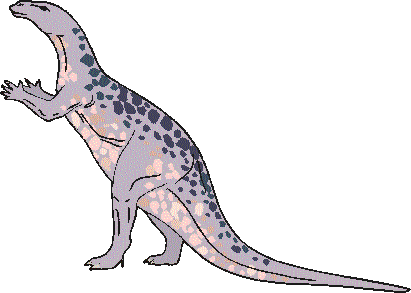
Camptosaurus
Camptosaurus was a herbivore (plant-eater) that lived in
Europe and North America
during the late Jurassic period,
about 155 to 145 million years ago.
Many
fossils have been found,
which suggests Camptosaurus was a common dinosaur in its time.
Camptosaurus legs were long and powerful, with 3 hoofed toes. Its arms
were much shorter, but also had hoof-like nails.
So while Camptosaurus could walk on two feet, it probably mostly walked on all
fours, and ate low lying vegetation.
Camptosaurus was about 20 feet (6.1 meters) long.
Camptosaurus was first described in 1879 by
Othniel C. Marsh.
Originally,
Othniel C. Marsh
named the creature "Camptonotus", but he changed the name to
Camptosaurus in 1885 because the original name was already being used for
a cricket. Both variants of the name mean "bent lizard", which
was chosen because the animal would have had to have its back arched whenever
standing on all fours.

Camptosaurus was a herbivore (plant-eater) that lived from 155 to 145 million years ago

Related Information & Resources
See Also

Camptosaurus Facts
Here is a summary of some of the key facts about Camptosaurus:
- Camptosaurus was a genus of dinosaur.
- "Camptosaurus" means "bent lizard" (because its body must have been arched when standing on all fours). The name was chosen by Othniel C. Marsh in 1885.
- Camptosaurus was a member of the Ornithischia ("bird-hipped") order of dinosaurs. What this means, is that although Camptosaurus was not closely related to birds, it did have similarly shaped pelvic bones.
- Camptosaurus lived between about 155 million years ago and 145 million years ago, during the Jurassic period.
- Camptosaurus lived in North America and Europe.
- Camptosaurus was a herbivore (plant-eater).
- Camptosaurus is thought to have mostly eaten low lying vegetation.
- Camptosaurus was about 20 feet (6.1 meters) long.
Camptosaurus Pictures and Posters
by AllPosters
Here are some Camptosaurus pictures and posters:
(Disclosure: Products details and descriptions provided by AllPosters. Our company may receive a payment if you purchase products from them after following a link from this website).
Camptosaurus Books Here are some books from Amazon.com:
Disclosure: Products details and descriptions provided by Amazon.com. Our company may receive a payment if you purchase products from them after following a link from this website.
Books LLC Paperback (134 pages)
 | List Price: $14.14* Lowest New Price: $14.14* Usually ships in 24 hours* *(As of 15:45 Pacific 2 Sep 2010 More Info)
Click Here | Product Description: Purchase includes free access to book updates online and a free trial membership in the publisher's book club where you can select from more than a million books without charge. Chapters: Iguanodon, Camptosaurus, Altirhinus, Talenkauen, Callovosaurus, Ouranosaurus, Dryosaurus, Muttaburrasaurus, Elrhazosaurus, Tenontosaurus, Kangnasaurus, Anabisetia, Mantellisaurus, Gadolosaurus, Planicoxa, Owenodon, Iguanodont, Theiophytalia, Lurdusaurus, Valdosaurus, Rhabdodon, Macrogryphosaurus, Dakotadon, Protohadros, Draconyx, Zalmoxes, Dryosauridae, Dollodon, Probactrosaurus, Jinzhousaurus, Rhabdodontidae, Fukuisaurus, Eolambia, Jintasaurus, Penelopognathus, Shuangmiaosaurus, Lanzhousaurus, Mochlodon, Bihariosaurus, Nanyangosaurus. Excerpt: Altirhinus (pronounced /æltrans/ ; "high snout") is a genus of iguanodontian ornithopod dinosaur from the Early Cretaceous Period of Mongolia . It was herbivorous and bipedal when walking or running, but probably became quadrupedal when feeding from the ground. The entire body probably extended 26 feet (8 m) from snout to tail tip. The skull alone is about 30 inches (760 mm) long, with a wide mouth and a distinctive tall arch on top of its snout, from which this dinosaur derives its name.The name was created in 1998 from a Latin word, altus ("high") and a Greek word, rhinos ("nose" or "snout"). There is one known species (A. kurzanovi ), which honors Sergei Kurzanov , the influential Russian paleontologist who originally found the specimens in 1981.History of Discovery All known specimens of Altirhinus were recovered in 1981 during collaborative expeditions organized by Soviet and Mongolian scientists, from the Khukhtek Formation in the Dornogovi Province of Mongolia . The Khukhtek was formed in the Aptian to Albian stages of the Early Cretaceous Period, which lasted from between 125 and 100 million years ago. Psittacosaurus and the primitive ankylosaurid Shamosaurus have also been found in these rocks.Several fossil specimens of differe... |
|
By Charles Whitney Gilmore
Smithsonian Inst Proc Unknown Binding
| Lowest Used Price: $14.90* *(As of 15:45 Pacific 2 Sep 2010 More Info)
Click Here |
|
Books LLC Paperback (50 pages)
| List Price: $14.14* Lowest New Price: $14.14* Usually ships in 24 hours* *(As of 15:45 Pacific 2 Sep 2010 More Info)
Click Here | Product Description: Les achats comprennent une adhésion à l'essai gratuite au club de livres de l'éditeur, dans lequel vous pouvez choisir parmi plus d'un million d'ouvrages, sans frais. Le livre consiste d'articles Wikipedia sur : Iguanodon, Abrictosaurus, Ouranosaure, Lesothosaurus, Camptosaurus, Leaellynasaura, Othnielia, Zalmoxes, Agilisaurus, Qantassaurus, Zephyrosaurus, Fulgurotherium, Draconyx, Thescelosaurus, Tenontosauridae. Non illustré. Mises à jour gratuites en ligne. Extrait : Iguanodon est un genre de dinosaure de l'ordre des ornithischiens c'est-à-dire des dinosaures caractérisés par un bassin semblable à celui d'un oiseau. Les iguanodons ont vécu au Crétacé inférieur, soit entre 155,7 et 93,5 Ma. Ils ont été retrouvés un peu partout (Europe, Asie, Afrique, Amérique). Le premier spécimen fut décrit par Gideon Mantell, à partir d'un tibia, quelques os et des dents. On en connaît en 2008, 81 fossiles. L'Iguanodon est assez populaire car c'est le deuxième dinosaure à avoir été décrit après le Megalosaurus. Il est caractérisé par un pouce pointu. Cet herbivore était à la fois bipède et quadrupède. Pour se défendre l'Iguanodon devait sûrement utiliser ses pouces comme poignards. Iguanodon signifie dent d'iguane. Ce nom vient du grec ancien odontos qui signifie dent et d'iguane (animal actuel dont le nom est d'origine arawak). Gideon Mantell lui donna ce nom à cause des quelques dents jugales découvertes à Wealden Rocks car il s'aperçut qu'elles ressemblaient à celles de l'iguane actuel. IguanodonL'iguanodon était très répandu au crétacé inférieur. Mesurant de haut, entre 6 à de long et pesant plus de . Ce dinosaure était à la fois bipède et quadrupède. Il avait un corps massif. On a retrouvé des empreintes fossilisées avec la trace des quatre pattes. Cependant, la plupart ne révèlent que les empreintes des membres postérieurs, et on suppose que les iguanodons juvéniles avaient les bras trop courts pour s'en servir lors de leurs déplacem...http://booksllc.net/?l=fr |
|
By Charles W. Gilmore
Smithsonian Institute Paperback
| Lowest Used Price: $25.00* *(As of 15:45 Pacific 2 Sep 2010 More Info)
Click Here |
|
By Othniel Charles Marsh
American Journal of Science Unknown Binding (246 pages)
| |
|
By Charles Whitney Gilmore
Smithsonian institution, United States National museum Unknown Binding
| |
|
By Bruce R Erickson
Science Museum of Minnesota Unknown Binding (13 pages)
| |
|
By Charles Whitney Gilmore
Govt. pr. off Unknown Binding
| |
|

Linking to This Page
Although this site is run on a commercial basis,
we do hope it will be useful and interesting for students and teachers.
We welcome people linking to this website, or citing us in their school and educational projects
(remember in school projects and papers, you should always cite your sources).
|
|
|