|
|
|
Tiktaalik
Click here for more Tiktaalik Pictures
| Scientific Classification |
|
|
|
|
|
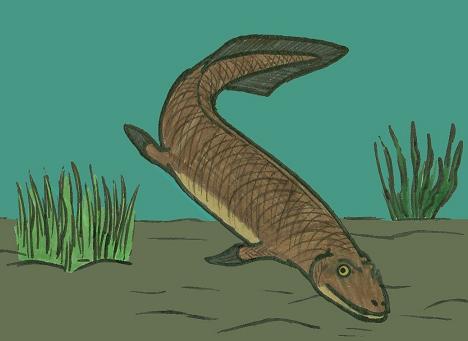
Tiktaalik is a lobe-finned fish that lived in the late Devonian period
about 375 million years ago. Its
fossils, which have
been found on Ellesmere Island in Nunavat,
Canada
show an animal that has a mix of fish-like and tetrapod-like
characteristics.
Fish-like features include gills and scales.
Tetrapod-like features include rib bones, mobile neck,
and evidence that it probably had lungs and was therefore
able to breathe in air.
Additionally, there are some features which
are intermediate between fish and tetrapods,
namely limb bones and joints which were similar
to tetrapods but ended in fish-like fins rather than toes,
and an ear region which seems intermediate between fish
and tetrapods.
Tiktaalik is thought to have lived on the bottom
of shallow waters, and perhaps even be able to emerge
from the water for short periods. It had rows of sharp
teeth, eyes on the top of its head (in a similar
position to a crocodiles),and was a predator.

Tiktaalik was an a lobe-finned fish with many tetrapod-like characteristics that lived about 375 million years ago

Related Information & Resources
See Also

Tiktaalik Books Here are some books from Amazon.com:
Disclosure: Products details and descriptions provided by Amazon.com. Our company may receive a payment if you purchase products from them after following a link from this website.
By Neil Shubin
PBS Released: 2009-01-06 Paperback (256 pages)
 | List Price: $14.95* Lowest New Price: $7.22* Lowest Used Price: $3.99* Usually ships in 24 hours* *(As of 01:53 Pacific 21 May 2012 More Info)
Click Here | Product Description: Details on a Major New Discovery included in a New AfterwordWhy do we look the way we do? Neil Shubin, the paleontologist and professor of anatomy who co-discovered Tiktaalik, the “fish with hands,” tells the story of our bodies as you've never heard it before. By examining fossils and DNA, he shows us that our hands actually resemble fish fins, our heads are organized like long-extinct jawless fish, and major parts of our genomes look and function like those of worms and bacteria. Your Inner Fish makes us look at ourselves and our world in an illuminating new light. This is science writing at its finest—enlightening, accessible and told with irresistible enthusiasm. |
|
By Sébastien Steyer
Indiana University Press Released: 2012-06-01 Paperback (200 pages)
 | List Price: $35.00* Lowest New Price: $22.64* Not yet published* *(As of 01:53 Pacific 21 May 2012 More Info)
Click Here | Product Description:
This beautiful volume introduces the incredible animals that populated the planet before the Age of the Dinosaurs. Readers voyage to a time, beginning about 370 million years ago, when the first four-footed vertebrates appeared, and ending 200 million years later at the moment when the dinosaurs begin their ascent. During this time, vertebrates emerge from the sea and there appears a parade of animals, each more astonishing than the last. On this expedition, we learn how paleontologists become detectives to understand the history of life and we discover that many widely held ideas about the evolution of species are completely false. Earth before the Dinosaurs is an entertaining and informative guide to an astonishing and little-known world. |
|
By Quelle: Wikipedia
Books LLC, Wiki Series Paperback (28 pages)
 | List Price: $14.14* Lowest New Price: $14.14* Lowest Used Price: $17.34* Temporarily out of stock. Order now and we'll deliver when available. We'll e-mail you with an estimated delivery date as soon as we have more information. Your credit card will not be charged until we ship the item.* *(As of 01:53 Pacific 21 May 2012 More Info)
Click Here | Product Description: Dieser Inhalt ist eine Zusammensetzung von Artikeln aus der frei verfügbaren Wikipedia-Enzyklopädie. Seiten: 26. Nicht dargestellt. Kapitel: Quastenflosser, Heteronectes chaneti, Tiktaalik, Pachycormidae, Panderichthys, Pycnodontiformes, Rhizodontia, Leedsichthys problematicus, Cheirolepis, Semionotiformes, Tarrasiidae, Palaeonisciformes, Ichthyodectiformes, Osteolepiformes, Dipterus, Priscacara, Elpistostegalia, Antennarius monodi, Gogonasus, Leptolepides sprattiformis, Macrosemiidae, Porolepiformes, Xiphactinus, Onychodontiformes, Lophosteiformes, Dapedium, Saurichthyidae, Guildayichthyidae, Lycoptera, Pholidophoriformes, Crossognathiformes, Aspidorhynchidae, Guiyu oneiros, Eusthenopteron, Eoactinistia, Perleidiformes, Leptolepidae, Knightia, Lycopteridae, Cetopangasius, Pholidopleuridae, Hyneria lindae, Araripichthys, Ptycholepidae, Scaumenacia, Luganoiidae, Ichthyodectes. Auszug: Die Quastenflosser (Coelacanthiformes („Hohlstachler", gr. κοῖλ-ος, hohl; ἄκανθ-α, Stachel, Dorn), Coelacanthimorpha, Actinistia) sind eine Gruppe der Knochenfische in der Klasse der Fleischflosser (Sarcopterygii). Ihre nächsten Verwandten sind die Lungenfische und die Landwirbeltiere (Tetrapoda). Die Quastenflosser gelten als das bekannteste Beispiel eines lebenden Fossils. Ihr Fossilbericht setzt im Unterdevon vor etwa 409 Millionen Jahren ein und bricht in der späten Oberkreide vor mehr als 70 Millionen Jahren ab. Daher ging man bis zur Entdeckung des rezenten Komoren-Quastenflossers (Latimeria chalumnae) 1938 im Indischen Ozean vor Südafrika davon aus, dass die Quastenflosser das Massenaussterben am Ende der Kreidezeit vor 65 Millionen Jahren nicht überstanden hatten. 1997 wurde vor der indonesischen Insel Sulawesi eine zweite Art, der Manado-Quastenflosser (Latimeria menadoensis) entdeckt. Fossil sind etwa 70 Arten in 28 Gattungen bekannt. Der Name „Quastenflosser" stammt von der veralteten wissenschaftlichen Bezeichnung „Crossopterygii" (gr. krossos „etwas Vorragendes", „Quast... |
|
By Lynn Sherr
PublicAffairs Hardcover (232 pages)
 | List Price: $25.99* Lowest New Price: $12.99* Lowest Used Price: $13.92* Usually ships in 24 hours* *(As of 01:53 Pacific 21 May 2012 More Info)
Click Here | Product Description:
Swim is a celebration of swimming and the effect it has on our lives. It’s an inquiry into why we swim—the lure, the hold, the timeless magic of being in the water. It’s a look at how swimming has changed over the millennia, how this ancient activity is becoming more social than solitary today. It’s about our relationship with the water, with our fishy forebearers, and with the costumes that we wear. You’ll even find a few songs to sing when you push out those next laps. Swimming enthusiast Lynn Sherr explores every aspect of the sport, from the biology of swimming to the fame of Esther Williams; from turquoise pools and wild water to the training of Olympians; and she reveals the secret of buoyancy so that anyone can avoid the example of the English poet Percy Bysshe Shelley, who lamented, “Why can’t I swim, it seems so very easy?” When his friend, the biographer Edward John Trelawny, said, “because you think you can’t,” Shelley plunged into Italy’s Arno River and dropped like a rock. With Swim, you can avoid that happening to you. |
|
By Ronald Cohn Jesse Russell
VSD Paperback
 | | Product Description: High Quality Content by WIKIPEDIA articles! Tiktaalik (pronounced /tɪkË?tÉ'Ëlɨk/ (deprecated template)) is a genus of extinct sarcopterygian (lobe-finned "fish") from the late Devonian period, with many features akin to those of tetrapods (four-legged animals). It is an example from several lines of ancient sarcopterygian "fish" developing adaptations to the oxygen-poor shallow-water habitats of its time, which led to the evolution of tetrapods. Well-preserved fossils were found in 2004 on Ellesmere Island in Nunavut, Canada. This book was created using print-on-demand technology. |
|
By Ken Ham
New Leaf Publishing Group/Master Books Paperback (300 pages)
 | List Price: $14.99* Lowest New Price: $6.71* Lowest Used Price: $5.99* Usually ships in 24 hours* *(As of 01:53 Pacific 21 May 2012 More Info)
Click Here | Product Description: The world around us provides irrefutable evidence of our Creator, but when challenged, can you defend your faith? Do you have answers to your own questions or those of your family about faith, evolution, creation, and a biblical worldview? Get the important information you need in this compelling third book from the popular Answers series, and learn more about: Global warming, the existence of God, questions for evolutionists, human and chimp DNA, Kinds in Genesis, Mount St Helens and the Grand Canyon, cloning and stem cells, bacteria and viruses, issues of eugenics and abortion, the universe - young or old?, what Noah s Ark looked like...and much more. Learn how to be more effective in defense of scriptural authority and the truth of Genesis as literal history. Join Ken Ham and leading creation scientists like Dr. Jason Lisle, Dr. Andrew Snelling, Dr. Georgia Purdom, Dr. David Menton, Dr. Terry Mortenson, Dr. John Morris, Dr. Steve Austin, Dr. David DeWitt, Dr. Danny Faulkner, Dr. Joe Francis, and others as they provide simple and empowering answers to these and other popular questions of faith in our culture today. Other exciting books available in the best-selling series: The New Answers Book 1, and The New Answers Book 2, with over 50 additional questions and answers. |
|
By Laurence Pringle
Boyds Mills Press Hardcover (112 pages)
 | List Price: $17.95* Lowest New Price: $11.01* Lowest Used Price: $11.46* Usually ships in 24 hours* *(As of 01:53 Pacific 21 May 2012 More Info)
Click Here |
|
By Gregg George
CrossBooks Publishing Paperback (116 pages)
 | List Price: $11.95* Lowest New Price: $10.51* Lowest Used Price: $10.87* Usually ships in 24 hours* *(As of 01:53 Pacific 21 May 2012 More Info)
Click Here | Product Description: They must be gullible to believe something that cannot be proven. They are easily led and can be made to believe things not supported by fact. They are victims of rules that stifle creativity. They are judgmental, with a "holier than thou" attitude. Who are "they"? To some people, "they" are Christians, and the statements represent issues people have with Christianity. In Christians Can't Lose, author Gregg George sets the record straight. He writes about the many issues people have against Christianity and explains why Christians believe what they do. He calls on skeptics to keep an open mind about a Christian's belief in God because supposed evidence to the contrary may not be as compelling as they think. George also calls on Christians to behave in a way that magnifies the Lord and shows the world the true love of Christ. He presents a case for believing in God simply because a believer cannot lose. Even if God does not exist, a Christian loses nothing for his belief. However, if God really does exist, a Christian will gain eternal life with God, while a nonbeliever will suffer eternal banishment from the presence of God. The choice should be quite simple. Christians Can't Lose will help nonbelievers learn more about what Christians believe and who they are. For Christians, the author reminds them how to be an effective role model and God's representative on earth. It is about understanding-on both sides of the belief coin. |
|
By Francisco J. Ayala
The Johns Hopkins University Press Hardcover (104 pages)
 | List Price: $12.95* Lowest New Price: $5.00* Lowest Used Price: $2.99* Usually ships in 24 hours* *(As of 01:53 Pacific 21 May 2012 More Info)
Click Here | Product Description:
Despite the ongoing cultural controversy in America, evolution remains a cornerstone of science. In this book, Francisco J. Ayala—an evolutionary biologist, member of the National Academy of Sciences, and winner of the National Medal of Science and the Templeton Prize—cuts to the chase in a daring attempt to address, in nontechnical language, six perennial questions about evolution: • Am I a Monkey?• Why Is Evolution a Theory?• What Is DNA?• Do All Scientists Accept Evolution?• How Did Life Begin?• Can One Believe in Evolution and God? This to-the-point book answers each of these questions with force. Ayala's occasionally biting essays refuse to lend credence to disingenuous ideas and arguments. He lays out the basic science that underlies evolutionary theory, explains how the process works, and soundly makes the case for why evolution is not a threat to religion. Brief, incisive, topical, authoritative, Am I a Monkey? will take you a day to read and a lifetime to ponder. (2011) |
|
Book on Demand Pod Unknown Binding
| |
|

Discuss This Page
Linking to This Page
We do hope that you find this site useful.
We welcome people linking to this website, or citing us in their school and educational projects
(remember in school projects and papers, you should always cite your sources).
|
|
|