|
|
|
Ichthyosaurs
Click here for more Ichthyosaur Pictures
| Scientific Classification |
|
|
|
|
| |
Superorder |
Ichthyopterygia |
|
|
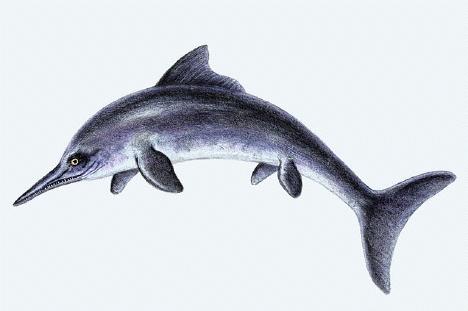
Ichthyosaurs were large marine reptiles that lived through most of the
Mesozoic Era.
They seem to have evolved from a group of terrestrial reptiles
(a group which is still to be identified) during the early
Triassic period,
about 245 million years ago, initially looking rather like lizards with fins.
Ichthyosaurs continued to evolve during the
Triassic period,
and both dolphin-like and somewhat serpent-like forms existed, the latter sometimes
growing to huge sizes, as much as 50 feet (15 meters) in length.
By the early Jurassic period,
Ichthyosaurs had reached their peak of diversity, and a long slow decline in diversity
continued through the
Jurassic and into the
Cretaceous period.
The last Icthyosaurs finally became extinct during the middle to late
Cretaceous,
perhaps about 90 million years ago.
In outward physical form, Ichthyosaurs tend to resemble whales, dolphins or sharks. This
is a result of convergent evolution - sharks, cetaceans (whales, dolphins and porpoises),
and ichthyosaurs all evolved similar body shapes, because it is a good hydrodynamic
solution for swimming.
Fossil Ichthyosaur, Argentina
Photographic Print
Perrine, Doug
Buy at AllPosters.com
One difference between Ichthyosaurs and many other marine predators, is
that it is believed that Ichthyosaurs probably hunted by sight (rather
than for example echo-location). Part of the evidence for this is that
Ichthyosaurs generally had comparatively large eyes - one particular
genus of Ichthyosaur, namely Temnodontosaurus which lived in
Jurassic
Europe
and was about 30 feet (12 meters) long, had the largest eyes of any
known vertebrate - its eyes were 10 inches (26 centimeters) in diameter.
Another noteworthy fact about Ichthyosaurs is that at least some species,
perhaps even all species, seem to have given birth to live young. The
evidence for this is that
fossils have been found
of Ichthyosaurs containing fossils of babies within the abdomen. It has
been suggested that perhaps these babies were stomach contents and therefore
evidence of cannibalism, however it seems more likely that
these fossils show
a pregnant Ichthyosaur that died just before (or perhaps even during)
giving birth.
Fossil fragments of Ichthyosaurs have been known since at least 1699, however the
the first complete fossil specimen was found by
Mary Anning in 1811 in Lyme Regis,
England
(Mary Anning
subsequently discovered three species of Ichthyosaur).
A large number of other fossils were also found by a
1905
expedition to central
Nevada,
including a 55 foot (17 meter) Shonisaurus (a very large, late
Triassic
Ichthyosaur), which since
1977,
has been designated as
Nevada's
State Fossil.

Ichthyosaurs were marine reptiles that lived between 245 and 90 million years ago

Related Information & Resources
See Also

Ichthyosaur Pictures and Posters
by AllPosters
Here are some Ichthyosaur pictures and posters:
(Disclosure: Products details and descriptions provided by AllPosters. Our company may receive a payment if you purchase products from them after following a link from this website).
Ichthyosaur Books Here are some books from Amazon.com:
Disclosure: Products details and descriptions provided by Amazon.com. Our company may receive a payment if you purchase products from them after following a link from this website.
By S.R. Howe & H.S. Torrens
National Museums and Galleries of Wales Paperback (32 pages)
 | Lowest Used Price: $79.51* *(As of 14:57 Pacific 2 Sep 2010 More Info)
Click Here |
|
By Dahl
Picture Window Books Paperback (24 pages; 1)
 | List Price: $7.95* Lowest New Price: $15.53* Lowest Used Price: $17.15* *(As of 14:57 Pacific 2 Sep 2010 More Info)
Click Here | Product Description: Provides information on the characteristics and life of the dinosaur known as Ichthyosaurus. |
|
By David Rains Wallace
University of California Press Paperback (320 pages)
 | List Price: $18.95* Lowest New Price: $5.91* Lowest Used Price: $6.09* Usually ships in 24 hours* *(As of 14:57 Pacific 2 Sep 2010 More Info)
Click Here | Product Description: Neptune's Ark illuminates the dramatic saga of evolution spanning 500 million years of marine life along the magnificent Pacific coast of western North America. In an engaging narrative that artfully blends elements of science, history, folklore, and personal observation, renowned naturalist David Rains Wallace reveals a marvelous diversity of creatures, not only modern ones, but those from the far prehistoric past. Mysterious forms have abounded--from giant sea cows, oyster bears, and flightless toothed birds to the orcas, elephant seals, and sea otters of modern times. Wallace tells a story about evolution as well as a tale of the storms, scurvy, and shipwrecks that plagued the coast's explorers, naturalists, and scientists, many of whom led turbulent or tragic lives, with themes reflected in the wonder and danger of the coast itself. Neptune's Ark is full of vivid characters--from explorers like Sir Francis Drake and Captain James Cook, to pioneer naturalists including Georg Steller and Charles Scammon, to early paleontologists Othniel Marsh and Edward Cope, and to recent scientists and ecological visionaries. |
|
| Convergent Evolution: Bird, Bat, Homology (biology), Pterosaur, Divergent evolution, Parallel evolution, Dorsal fin, Ichthyosaur, Shark, Ecology, Evolution ... List of examples of convergent evolution |
Alphascript Publishing Paperback (152 pages)
 | List Price: $71.00* Lowest New Price: $63.90* Lowest Used Price: $157.40* Usually ships in 24 hours* *(As of 14:57 Pacific 2 Sep 2010 More Info)
Click Here | Product Description: Convergent evolution describes the acquisition of the same biological trait in unrelated lineages. The wing is a classic example of convergent evolution in action. Although their last common ancestor did not have wings, birds and bats do, and are capable of powered flight. The wings are similar in construction, due to the physical constraints imposed upon wing shape. Similarity can also be explained by shared ancestry, as evolution can only work with what is already there?thus wings were modified from limbs, as evidenced by their bone structure. Traits arising through convergent evolution are termed analogous structures, in contrast to homologous structures, which have a common origin. Bat and pterodactyl wings are an example of analogous structures, while the bat wing is homologous to human and other mammal forearms, sharing an ancestral state despite serving different functions. Similarity in species of different ancestry which is the result of convergent evolution, is called homoplasy. The opposite of convergent evolution is divergent evolution, whereby related species evolve different traits. |
|
Books LLC Paperback (36 pages)
 | List Price: $61.81* Lowest New Price: $61.81* Lowest Used Price: $78.95* Usually ships in 24 hours* *(As of 14:57 Pacific 2 Sep 2010 More Info)
Click Here | Product Description: Purchase includes free access to book updates online and a free trial membership in the publisher's book club where you can select from more than a million books without charge. Chapters: Flora of Nevada, Panicum Virgatum, Ichthyosaur, Kayenta Formation, Artemisia Tridentata, Meesia Triquetra, Astragalus Lemmonii, Hieracium Horridum, Lake Bonneville, Meesia Uliginosa, Lupinus Latifolius Var. Barbatus, Ptilidium Californicum, Camassia Quamash, Salvia Dorrii, Bruchia Bolanderi, Red Osier Dogwood, Cordylanthus Capitatus, Madrean Region, Yucca Baccata, Lomatium Roseanum, Atriplex Lentiformis, Thelypodium Howellii, Bouteloua Dactyloides, Pinedrops, Rhus Trilobata, Fouquieria Splendens, Grindelia Fraxino-Pratensis, Hibiscus Denudatus, Vallisneria Americana, Nitrophila Mohavensis, Montia Fontana, Salvia Columbariae, Fagonia Laevis, Berlin-ichthyosaur State Park, Phoradendron Leucarpum, Bouteloua Eriopoda, Tiquilia Canescens, Hecastocleis, Baby Blue Eyes, Lycium Andersonii, Sarcostemma Hirtellum, Pedicularis Semibarbata, Psorothamnus Fremontii, Chaenactis Alpigena, Phacelia Cicutaria, Sphaeralcea Ambigua, Cirsium Andersonii, Ethel M Botanical Cactus Garden, Nicotiana Obtusifolia, Draba Verna, Polemonium Chartaceum, Calochortus Leichtlinii, Nama Lobbii, Mimulus Mephiticus, Atriplex Hymenelytra, Asclepias Eriocarpa, Ranunculus Glaberrimus, Ceratocephala Testiculata, Polemonium Viscosum, Ivesia Aperta, Croton Californicus, Penstemon Albomarginatus, Cirsium Douglasii, Oryctes, Keckiella Breviflora, Gentiana Newberryi, Phoenicaulis Cheiranthoides, Tiquilia Plicata, Penstemon Floridus, Ceanothus Cordulatus, Twinleaf Onion, Penstemon Fruticiformis, Lessingia Lemmonii, Chaenactis Nevadensis, Senecio Fremontii, Calycadenia Multiglandulosa, Abronia Turbinata, Brickellia Nevinii, Gentianopsis Holopetala, Eriogonum Lobbii, Encelia Actoni, Delphinium Polycladon, Cleomella Obtusifolia, Penstemon Barnebyi, Astragalus Johannis-Howellii, Polyctenium Fremontii, Gilia Cana, Phyllodoce Brew... |
|
Books LLC Paperback (50 pages)
 | List Price: $14.14* Lowest New Price: $14.14* Usually ships in 24 hours* *(As of 14:57 Pacific 2 Sep 2010 More Info)
Click Here | Product Description: Purchase includes free access to book updates online and a free trial membership in the publisher's book club where you can select from more than a million books without charge. Chapters: Shonisaurus, Cymbospondylus, Besanosaurus, Mixosaurus, Utatsusaurus, Californosaurus, Chaohusaurus, Shastasaur, Grippia, Contectopalatus, Omphalosaurus, Leptopterygiidae, Thaisaurus, Shastasaurus, Qianichthyosaurus, Guizhouichthyosaurus, Pessosaurus, Parvinatator. Excerpt: Shonisaurus is the largest ichthyosaur and marine reptile that has yet been found. Fossils of Shonisaurus were first found in a large deposit in Nevada in 1920. Thirty years later, they were excavated, uncovering the remains of 37 very large ichthyosaurs. These were named Shonisaurus, which means "Lizard from the Shoshone Mountains", after the formation where the fossils were found. Shonisaurus lived during the Norian stage of the late Triassic period. The better known S. popularis species was around 15 metres (49 ft) long, but a more recently discovered species, S. sikkanniensis, was longer still, at 21 metres (69 ft). Shonisaurus had a long pointed mouth that contained teeth only at the front end. It had a large whale-like body, a long dolphin-like snout, and its flippers were much longer, and narrower than in other ichthyosaurs. All of these features suggest that Shonisaurus may be a relatively specialised offshoot of the main ichthyosaur evolutionary line. The two known species of Shonisaurus with an adult human to scale. S. popularis.The first species discovered, S. popularis, was adopted as the State Fossil of Nevada in 1984. Excavations, begun in 1954 under the direction of Dr. Charles Camp and Dr. Samuel Welles of the University of California, Berkeley, were continued by Camp throughout the 60s. It was named by Charles Camp in 1976. The Nevada fossil sites can currently be viewed at the Berlin-Ichthyosaur State Park. The discovery of S. sikkanniensis in British Co... More: http://booksllc.net/?id=3098635 |
|
By Christopher McGowan
Royal Ontario Museum Unknown Binding (37 pages)
| Lowest Used Price: $3.00* *(As of 14:57 Pacific 2 Sep 2010 More Info)
Click Here |
|
Books LLC Paperback (64 pages)
| List Price: $14.14* Lowest New Price: $14.14* Lowest Used Price: $31.34* Usually ships in 24 hours* *(As of 14:57 Pacific 2 Sep 2010 More Info)
Click Here | Product Description: Kapitel: Area 51, Sierra Nevada, Prometheus, Berlin-Ichthyosaur State Park, Inyo National Forest, Beckwourth Trail, Mojave-Wüste, Yucca Mountain, Valley of Fire, Cave Lake State Park, Pahranagat Valley, Great-Basin-Nationalpark, Virgin Mountains, Fish Lake Valley, Pyramid Island. Aus Wikipedia. Nicht dargestellt. Auszug: Area 51 is a name used in official CIA documents (at least since 1967) for a military base that is located in the southern portion of Nevada in the western United States, 83 miles (133 km) north-northwest of downtown Las Vegas. Situated at its center, on the southern shore of Groom Lake, is a large secretive military airfield. The base's primary purpose is to support development and testing of experimental aircraft and weapons systems. The base lies within the United States Air Force's vast Nevada Test and Training Range. Although the facilities at the range are managed by the 99th Air Base Wing at Nellis Air Force Base, the Groom facility appears to be run as an adjunct of the Air Force Flight Test Center (AFFTC) at Edwards Air Force Base in the Mojave Desert, around 186 miles (300 km) southwest of Groom, and as such the base is known as Air Force Flight Test Center (Detachment 3). Other names used for the facility include Dreamland, Paradise Ranch, Home Base, Watertown Strip, Groom Lake, and most recently Homey Airport. The area is part of the Nellis Military Operations Area, and the restricted airspace around the field is referred to as (R-4808N), known by the military pilots in the area as "The Box" or "the Container". The intense secrecy surrounding the base, the very existence of which the U.S. government barely acknowledges, has made it the frequent subject of conspiracy theories and a central component to unidentified flying object (UFO) folklore. Map showing Area 51, NAFR, and the NTSArea 51 shares a border with the Yucca Flat region of the Nevada Test Site (NTS), the location of 739 of the 928 nuclear...http://booksllc.net/?l=de |
|
By Editor.
University of Wyoming Paperback
| Lowest Used Price: $8.00* *(As of 14:57 Pacific 2 Sep 2010 More Info)
Click Here |
|
By R. B. et al. Parker
University of Wyoming Paperback
| Lowest Used Price: $13.00* *(As of 14:57 Pacific 2 Sep 2010 More Info)
Click Here |
|

Linking to This Page
Although this site is run on a commercial basis,
we do hope it will be useful and interesting for students and teachers.
We welcome people linking to this website, or citing us in their school and educational projects
(remember in school projects and papers, you should always cite your sources).
|
|
|