|
|
|
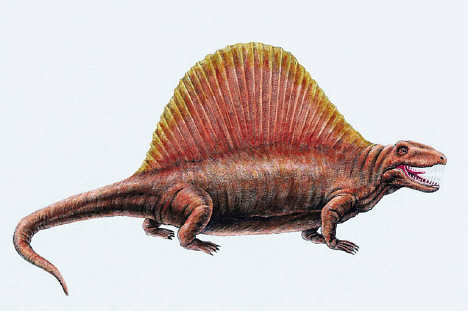
Dimetrodon
Click here for more Dimetrodon Pictures
| Scientific Classification |
|
|
|
|
|
|
|
Dimetrodon is probably the best-known of the
mammal-like reptiles. It was a predator that
lived in the Permian period between about
280 million and 265 million years ago.
Dimetrodon is believed to have been the largest predator
in its habitat. Adults were up to 11 feet (3.5 meters)
in length. It had four sprawling legs, and a large
tail, and probably walked in a similar manner to lizards.
It most noteable feature however is the large sail
on its back.
Dimetrodon's sail was filled with blood vessels and
is believed to have mainly served to help in
regulating body temperature. By facing the sail
towards the sun, Dimetrodon could heat itself
up quickly, and it could also use the sail to cool itself
if it became too hot. Additionally, the sail
may have served a number of secondary purposes such
as attracting mates, or helping to deter other
predators (by making the animal appear larger
than it was).
The name Dimetrodon means "two measures of teeth",
and was chosen in 1878 by
Edward D. Cope.
This name reflects the fact that the animal's skull contains two
different types of teeth (unlike reptiles which normally only
contain a single type of teeth) - namely
sharp canine teeth, and shearing teeth.
Fossils
of Dimetrodon have so been found in
North America and
Europe.
As well as
fossils of the animal
itself,
fossilized Dimetrodon
footprints have also been found.

Dimetrodon was a carnivorous (meat-eating) mammal-like reptile that lived between 280 and 265 million years ago

Related Information & Resources
See Also

Dimetrodon Pictures and Posters
by AllPosters
Here are some Dimetrodon pictures and posters:
(Disclosure: Products details and descriptions provided by AllPosters. Our company may receive a payment if you purchase products from them after following a link from this website).
Dimetrodon Books Here are some books from Amazon.com:
Disclosure: Products details and descriptions provided by Amazon.com. Our company may receive a payment if you purchase products from them after following a link from this website.
By Abrams
Harry N. Abrams Board book (12 pages; 1)
 | List Price: $6.95* Lowest New Price: $6.00* Lowest Used Price: $0.01* *(As of 14:33 Pacific 2 Sep 2010 More Info)
Click Here | Product Description: Now children can keep their favorite animals, bugs, and other creatures as pets-and hold dinosaurs or the sun and moon in their hands! These irresistible little board books are small enough to fit in a tiny fist or the pocket of a backpack. Printed on sturdy boards with brief text in large bold type, Portables are great for bedtime reading or playtime. Young children will want to collect the entire series! So innovative they have been patented! Tyrannosaurus rex-the most fearsome of all dinosaurs-and Dimetrodon are two new dinos that stand up on their own! These books provide interesting facts about the ancient beasts and are ready for hours of playtime. Both dinosaur books have been vetted by the American Museum of Natural History, New York. 12 panels illustrated in full color, approximately 51/2 x 51/2" |
|
By Tamara Green
Gareth Stevens Publishing Library Binding (24 pages; 1)
 | List Price: $19.93* Lowest New Price: $1.34* Lowest Used Price: $0.74* *(As of 14:33 Pacific 2 Sep 2010 More Info)
Click Here | Product Description: Describes the physical characteristics and habits of this prehistoric sail-backed reptile. |
|
Books LLC Paperback (42 pages)
 | List Price: $14.14* Lowest New Price: $14.14* Lowest Used Price: $15.25* Usually ships in 24 hours* *(As of 14:33 Pacific 2 Sep 2010 More Info)
Click Here |
|
By Dale Down
Athena Press Paperback (48 pages; 1)
 | List Price: $9.94* Lowest New Price: $6.75* Lowest Used Price: $9.95* Usually ships in 24 hours* *(As of 14:33 Pacific 2 Sep 2010 More Info)
Click Here | Product Description: Join Dennis and all his dinosaur friends in their adventures in the park. When Dennis learns how to play with a skipping rope he gets much more than he bargained for and even makes a new friend in a very unusual place. . . |
|
Books LLC Paperback (56 pages)
 | List Price: $14.14* Lowest New Price: $14.14* Lowest Used Price: $15.17* Usually ships in 24 hours* *(As of 14:33 Pacific 2 Sep 2010 More Info)
Click Here | Product Description: Purchase includes free access to book updates online and a free trial membership in the publisher's book club where you can select from more than a million books without charge. Chapters: Oligokyphus, Dimetrodon, Edaphosaurus, Estemmenosuchus, Dicynodon, Inostrancevia, Suminia, Biarmosuchus, Titanophoneus, Hahnia, Lepagia, Eotitanosuchus, Dvinia, Procynosuchus, Haptodus, Ivantosaurus, Neosaurus, Megawhaitsia. Excerpt: Oligokyphus was an advanced herbivorous cynodont of the late Triassic to early Jurassic periods. Originally considered to be an early mammal, it is now classified as a synapsid because Oligokyphus does not have the mammalian jaw attachments and it retains a vestigial joint between the quadrate bone and the squamosal bone in the skull. Oligokyphus (meaning "small curved animal"), was a small animal, around 50 centimetres (20 in) in length, belonging to the herbivorous Tritylodontidae family. It resembled a weasel in appearance, with a long and slim body. The limbs sat directly under the body, like modern mammals, but unlike other known synapsids. The skeleton of OligokyphusOligokyphus was found widely across North America, Europe and China. This indicates that there were substitutes with the terrestrial vertebrates. The teeth of the upper and lower jaw contain bump rows that fit together perfectly in order to maintain an accurate bite. Oligokyphus had a face similar to that of modern mammals, although there were differences in the cheekbones and eyesockets. It had a bony secondary palate and double-rooted cheek teeth. Unlike mammals, the teeth of Oligokyphus did not occlude. The jaw was double jointed, and the neck was flexible, with an atlas and axis and a double occipital condyle. The teeth were different from those of related cynodonts; there were no canine teeth, and unusually large, rodent-like incisors. There is a large gap, or diastema, separating the cheek teeth from the incisors. The lower jaw of these ... More: http://booksllc.net/?id=2969792 |
|
Books LLC Paperback (64 pages)
 | List Price: $14.14* Lowest New Price: $14.14* Usually ships in 24 hours* *(As of 14:33 Pacific 2 Sep 2010 More Info)
Click Here | Product Description: Purchase includes free access to book updates online and a free trial membership in the publisher's book club where you can select from more than a million books without charge. Chapters: Oligokyphus, Dimetrodon, Edaphosaurus, Cotylorhynchus, Placerias, Archaeothyris, Tetraceratops, Ianthasaurus, Ophiacodon, Angelosaurus, Haptodus, Ctenospondylus, Caseoides, Oedaleops, Bathygnathus, Varanops, Secodontosaurus, Clepsydrops, Eothyris, Caseopsis, Chronoperates. Excerpt: Angelosaurus dolani ('Dolan's Angel lizard', Olson |
|
By Rupert Oliver
Rourke Publishing (FL) School & Library Binding (20 pages; 1)
| List Price: $15.33* Lowest New Price: $8.99* Lowest Used Price: $0.01* *(As of 14:33 Pacific 2 Sep 2010 More Info)
Click Here | Product Description: Sleeping and hunting for meat keep Dimetrodon busy in his prehistoric day. |
|
By Elizabeth J. Sandell
Bancroft-Sage Publishing Paperback (32 pages; 1)
| List Price: $7.95* Lowest New Price: $7.00* *(As of 14:33 Pacific 2 Sep 2010 More Info)
Click Here | Product Description: A description of a reconstructed Dimetrodon skeleton introduces scientific speculation about how the sail-backed dinosaur looked and behaved. |
|
By Rupert Oliver
Rourke Enterprises Hardcover
| Lowest Used Price: $3.00* *(As of 14:33 Pacific 2 Sep 2010 More Info)
Click Here |
|
By Mary Packard
Playskool Unknown Binding
| Lowest Used Price: $9.98* *(As of 14:33 Pacific 2 Sep 2010 More Info)
Click Here |
|

Linking to This Page
Although this site is run on a commercial basis,
we do hope it will be useful and interesting for students and teachers.
We welcome people linking to this website, or citing us in their school and educational projects
(remember in school projects and papers, you should always cite your sources).
|
|
|