|
|
|
Pterosaurs
Click here for more Pterosaur Pictures
| Scientific Classification |
|
|
|
|
|
Pterosaurs (which means "winged lizard")
which are also sometimes popularly known as "Pterodactyls"
(which means "winged finger")
were winged reptiles that evolved during the late
Triassic period,
about 220 million years ago,
and survived until the
Cretaceous-Tertiary mass extinction,
about 65 million years ago.
Although contemporary with the dinosaurs,
Pterosaurs were not dinosaurs, although
they were also members of the Archosaur group of reptiles (the group that also
includes
dinosaurs, birds, crocodilians,
and Champsosaurs).
The smallest Pterosaurs were about the size of a small bird, but the largest,
such as Quetzalcoatlus had a wingspan of as much as 36 feet (11 meters).
Most (or perhaps even) all smaller Pterosaur species seemed to have died out before
the end of the
Cretaceous period,
and it is thought that this might have been due to competition from birds.
By the time of the Cretaceous-Tertiary mass extinction,
only the Pterosaurs survived, and these of course died out during that extinction.
Pterosaurs evolved flight independently and separately from birds, but
incorporated a number of bird-like features. Their bones were hollow
and air filled, which reduced their weight, that had breastbone to which
they flight muscles were attached, and they seem to have brain adaptations
which would have helped them fly. It was once thought that Pterosaurs were
mainly gliders, but today many scientists believe that atleast some species
were active flyers.
Pterosaurs wings were a membrane that
stretched from an elongated fourth finger of each arm, and joined to the body.
Some paleontologists have argued that the wing membrane would also have joined
to the hind limbs, but others say this would not have been the case - it is also
possible that the extent of the wing membrane depended on the particular species.
It is also known that atleast some Pterosaurs had webbed feet, and while it is
possible that these may have been used for swimming, it is also possible that
they may have assisted in flying.
There is also evidence that at least some species of Pterosaurs had hair. Pterosaur
hair evolved independently of mammalian hair, and would have a different structure,
although similar function to that of a mammals. The presence of hair suggests that
Pterosaurs were probably warm-blooded ("endothermic").
When walking on the ground, Pterosaurs probably had a semi-erect posture.
There was once much debate about whether they walked on two legs (bipedally)
or four legs (quadrupedally), but
fossil tracks that have been
found, show they were quadrupeds.
The first Pterosaur fossil
was found in 1784 by Cosimo Collini, who believed he had found a
sea creature
(although the eminent naturalist Georges Cuvier
suggested that Pterosaurs were flying creatures as early as 1801,
the aquatic hypothesis about the creatures continued to be supported
by some scientists until at least the 1830s).
Other early discoveries include a find of the Pterosaur
Dimorphodon by Mary Anning
in Lyme Regis, England
in 1828.
Today, at least 60 different genera of Pterosaurs are known, and
fossil have been found
in every continent except Antarctica. Since Pterosaur bones were hollow,
unfortunately they tended to be crushed when buried under sediments, so
many fossils are
poorly preserved. However, fortunately there is an exception -
for some unknown reason the bones in Pterosaurs
found in the Araripe Plateau in Brazil were
not crushed during the
fossilization process.
Additionally, as already noted,
fossil Pterosaur
trackways have been found. Furthermore, one
fossil Pterosaur
egg has been found - which although squashed, was not cracked (suggesting
Pterosaur eggs were soft and leathery) - contained an embryo containing well-developed
wing membranes.
Because Pterosaur fossils
are not always well-preserved, and there are many gaps in the
fossil record,
there has been much debate about how Pterosaurs evolved, and how to classify
them. Traditionally, Pterosaurs are generally classified into two suborders -
the Rhamphorhynchoidea, which were "primitive" Pterosaurs, with long
tails and fingers adapted to climbing - and the
Pterodactyloidea, which were "advanced" Pterosaurs, with shorter tails, long
wing metacarpals.
Fossils of Pterosaurs
have been found around the world including in
England,
Norway,
the
united States,
Mexico,
South America, and
Australia.

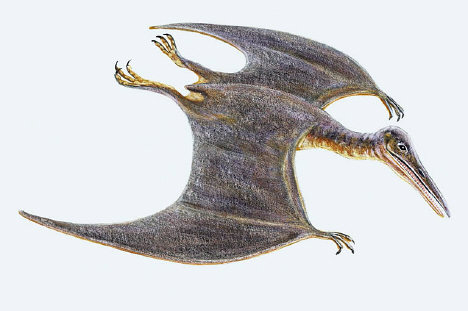
Pterosaurs were winged reptiles that lived between 220 and 65 million years ago

Related Information & Resources
See Also

Pterosaur Pictures and Posters
by AllPosters
Here are some Pterosaur pictures and posters:
(Disclosure: Products details and descriptions provided by AllPosters. Our company may receive a payment if you purchase products from them after following a link from this website).
Pterosaur Books Here are some books from Amazon.com:
Disclosure: Products details and descriptions provided by Amazon.com. Our company may receive a payment if you purchase products from them after following a link from this website.
By Elaine Landau
Children's Press(CT) Paperback (48 pages; 1)
 | List Price: $6.95* Lowest New Price: $6.95* Lowest Used Price: $0.01* Temporarily out of stock. Order now and we'll deliver when available. We'll e-mail you with an estimated delivery date as soon as we have more information. Your credit card will not be charged until we ship the item.* *(As of 07:52 Pacific 2 Sep 2010 More Info)
Click Here | Product Description: Describes the characteristics and behavior of the extinct flying reptile that lived on the earth during the Mesozoic era. |
|
By Jonathan Whitcomb
WingSpan Press Paperback (264 pages)
 | List Price: $16.00* Lowest New Price: $14.40* Lowest Used Price: $16.76* Usually ships in 24 hours* *(As of 07:52 Pacific 2 Sep 2010 More Info)
Click Here | Product Description: Expanded second edition: An American flight instructor, an Australian psychologist, many natives on tropical islands, an Australian couple, a Baptist minister, a teenaged farm-boy--each saw a giant living pterosaur. Each was amazed, or terrified, or shocked by a brown or dark-colored featherless creature: long-tailed and with a wingspan as great as fifty feet. Why have many Western scientists been wrong about universal extinctions? Read how standard models of macro-evolution have actually caused the problem, indoctrinating millions into believing that pterosaurs are extinct and ancient. They live now. |
|
By Karen Miller
Henry Holt and Co. (BYR) Released: 2007-03-29 Hardcover (96 pages; 1)
 | List Price: $17.95* Lowest New Price: $4.85* Lowest Used Price: $2.18* Usually ships in 24 hours* *(As of 07:52 Pacific 2 Sep 2010 More Info)
Click Here | - ISBN13: 9780805079029
- Notes: BUY WITH CONFIDENCE, Over one million books sold! 98% Positive feedback. Compare our books, prices and service to the competition. 100% Satisfaction Guaranteed
Product Description:
Mythical beasts or real creatures? You decide!
Big Foot, Moth Man, the Sea Serpent of Gloucester. These are just a few of the mythical beasts uncovered in this intriguing collection of extraordinary creatures. Firsthand accounts and the opinions of scientists weave together a fascinating web of fact and legend. Whether you’re a skeptic or a believer, you’ll find much to ponder in the lore surrounding these monsters. |
|
By Geological Society Publishing
Geological Society of London Hardcover (347 pages)
 | List Price: $190.00* Lowest New Price: $152.00* Lowest Used Price: $133.57* Usually ships in 24 hours* *(As of 07:52 Pacific 2 Sep 2010 More Info)
Click Here | Product Description: Pterosaurs were a peculiar group of Mesozoic vertebrates, which acquired the ability to fly in an original way, using a membrane attached to a single finger of the hand. Ever since the first description of a pterosaur skeleton in 1784, these remarkable animals have elicited much discussion and controversy among palaeontologists, and many basic questions about their origin, evolution and biology remain disputed. In the last few years, interest in pterosaurs has been revived by numerous discoveries of new and sometimes remarkably preserved specimens, which have enlarged and changed our picture of this group. The volume begins with descriptions of several new pterosaurs from the Triassic, Jurassic and Cretaceous of Europe, North and South America, and Africa. Following this, alternative hypotheses of pterosaur phylogeny and evolution are put forward. Several papers discuss the functional anatomy of pterosaurs and its implications for aerial locomotion. The study of pterosaur footprints provides important new evidence concerning their terrestrial locomotion, and this approach is used in several contributions. A developing aspect of pterosaur research is bone histology, as shown by the final papers in this collection. Also available: The Rise and Fall of the Ediacaran Biota - Special Publication No 286 - ISBN 978-1-86239-233-5 Evolutionary Biology of the Bivalvia - Special Publication No 177 - ISBN 978-1-86239-076-8 The Geological Society of London Founded in 1807, the Geological Society of London is the oldest geological society in the world, and one of the largest publishers in the Earth sciences. The Society publishes a wide range of high-quality peer-reviewed titles for academics and professionals working in the geosciences, and enjoys an enviable international reputation for the quality of its work. The many areas in which we publish in include: -Petroleum geology -Tectonics, structural geology and geodynamics -Stratigraphy, sedimentology and paleontology -Volcanology, magmatic studies and geochemistry -Remote sensing -History of geology -Regional geology guides |
|
By Caroline Arnold
Clarion Books Hardcover (40 pages; 1)
 | List Price: $16.00* Lowest New Price: $7.82* Lowest Used Price: $0.01* Usually ships in 24 hours* *(As of 07:52 Pacific 2 Sep 2010 More Info)
Click Here | Product Description:
One hundred million years ago, the skies were filled with enormous flying reptiles. With wings spans up to nearly forty feet, pterosaurs were the dominant life form on earth. The relationship of these giants of the air to dinosaurs and to other reptiles, their varied appearance and lifestyles, their evolution and extinction, the fossil discoveries that scientists are continually making throughout the world—all are depicted in this beautifully illustrated, accessible book for young scientists and their parents and teachers. Once again, acclaimed science author Caroline Arnold and meticulous watercolorist Laurie Caple have teamed up to create an eye-opening look at an amazing group of prehistoric animals and what the world was like when these incredible creatures ruled the skies of earth. Index.
|
|
By Susan Heinrichs Gray
Child's World Library Binding (32 pages; 1)
 | List Price: $27.07* Lowest New Price: $23.57* Lowest Used Price: $14.55* Usually ships in 24 hours* *(As of 07:52 Pacific 2 Sep 2010 More Info)
Click Here |
|
By Jenny Nimmo
Walker Books Ltd Paperback (80 pages)
 | List Price: $6.33* Lowest New Price: $52.27* Lowest Used Price: $0.73* *(As of 07:52 Pacific 2 Sep 2010 More Info)
Click Here | Product Description: Tom discovers his neighbours are hiding an amazing secret in this exciting illustrated fiction title. At the bottom of the Tuttle family's garden rises a huge hedge, as tall and as solid as the wall of a castle. Behind it live the Grimleys, but what they're trying to hide no one knows. Then one evening Tom Tuttle hears an eerie wailing. What sort of creature could make such a noise - a noise that stops when Tom's sisters sing? And if he uncovers the truth, will anyone believe him? |
|
By David M. Unwin
Pi Press Hardcover (352 pages)
| List Price: $39.95* Lowest New Price: $100.00* Lowest Used Price: $23.91* *(As of 07:52 Pacific 2 Sep 2010 More Info)
Click Here | Product Description:
Here is the first complete portrait of the legendary flying dragons of deep time–the pterosaurs–designed for non-specialists, yet founded on the real science of these bizarre creatures. Presented lucidly and accessibly by one of the world’s leading experts, David Unwin’s book is built on a mountain of new fossil discoveries and the latest research. About 220 millions years ago, a group of reptiles took to the Earth’s vast and open skies. No longer tethered to the ground, the earliest pterosaurs evolved into a multitude of diverse forms, spread around the globe, and ruled the skies until they went extinct along with the dinosaurs about 65 millions years ago, rarely leaving fossils as a record of their existence. What they did leave was a mystery for paleontologists to solve; an enigma so difficult to crack that it took centuries of false starts and missteps before the path to a true understanding of pterosaurs was uncovered. Now, an understanding of the fundamental nature of these strange creatures is finally possible. In the last 15 years, stunning new fossil finds and significant advances in technology have led to a breakthrough in our knowledge of pterosaurs. New fossils of the earliest species were discovered in Italy, a remarkably well-preserved and complete wing was found in Central Asia, and, most extraordinarily, a pterosaur embryo inside an egg was unearthed in China. CAT scanning has let researchers glimpse inside pterosaur skulls and construct three-dimensional images of their bodies from crushed bones, and modern techniques for analyzing relationships between species have revealed surprising insights into the evolution of the group. Drawing on these and other advances, David Unwin, caretaker of Archaeopteryx and curator at the Museum of Natural History in Berlin, paints pterosaurs and their world more vividly than has previously been possible. He eloquently reconstructs their biology and behavior. Pterosaurs weren’t scaly like dinosaurs, but hairy; most were brightly colored and adorned with remarkable head crests; they were excellent fliers with physiologically sophisticated wings; they walked on all fours; and varied in size from eight inches to forty feet in wingspan. He shows how they lived their lives, raised their young, and interacted with the different environments of Mesozoic Earth. Then, building on his thorough examination of their anatomy and lifestyle, and using the powerful technique of cladistic analysis, Unwin unravels the evolutionary history of pterosaurs and establishes their place in the one great tree of life. Packed with 95 color and 30 black and white illustrations–including 10 full-page original color paintings that are scientific recreations of different pterosaur species–The Pterosaurs From Deep Time takes readers on an wondrous expedition back through the lost world of the Earth’s deep past. |
|
By Peter Wellnhofer
Salamander Books Hardcover (192 pages)
| Lowest New Price: $270.44* Lowest Used Price: $4.44* *(As of 07:52 Pacific 2 Sep 2010 More Info)
Click Here |
|
By Sankar Chatterjee
Geological Society of America Paperback (64 pages)
| List Price: $50.00* Lowest New Price: $38.50* Lowest Used Price: $102.32* *(As of 07:52 Pacific 2 Sep 2010 More Info)
Click Here |
|

Linking to This Page
Although this site is run on a commercial basis,
we do hope it will be useful and interesting for students and teachers.
We welcome people linking to this website, or citing us in their school and educational projects
(remember in school projects and papers, you should always cite your sources).
|
|
|