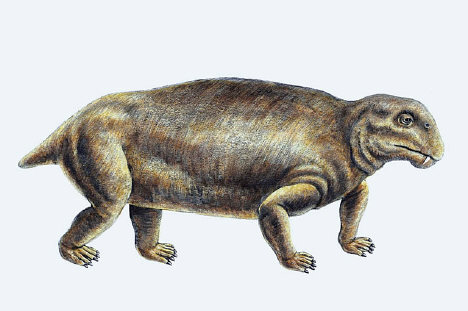
Dicynodonts were a group of
mammal-like reptiles
that first appeared in
the Permian period about 268 million years ago, and survived through to
the Cretaceous period
about 105 million years ago. Until recently it was thought that
all Dicynodonts died out before the end of the
the Triassic period,
but recently discovered evidence suggested that they may have
survived in southern Gondwana (now Australia)
until the Cretaceous period.
During the late Permian period, Dicynodonts were the most successful of land vertebrates,
and occupied a range of evolutiontary niches. Many species died out in the Permian-Triassic
extinction, but two families survived, and they and their descendents (especially Lystrosaurs)
were the most successful herbivores of the early
Triassic period.
Dicynodonts vary in size from being about the size
of a rat to about the size of a horse, and were all herbivores (plant-eaters).
Their bodies are usually short and strong with a short tail but powerful limbs - in larger
species the hind limbs are erect, but the front limbs sprawl at the elbow.
Additionally, in all but the earliest forms, Dicynodonts have a horny beak.
The name "Dicynodont" was coined by
Sir Richard Owen
in 1859 and means "two dog teeth". It refers to the two tusks that the animals
had.
CERTAIN CONTENT THAT APPEARS ON THIS SITE COMES FROM AMAZON SERVICES LLC. THIS CONTENT IS PROVIDED 'AS IS' AND IS SUBJECT TO CHANGE OR REMOVAL AT ANY TIME. CERTAIN CONTENT THAT APPEARS ON THIS SITE,COMES FROM AMAZON EU S.à r.l. THIS CONTENT IS PROVIDED 'AS IS' AND IS SUBJECT TO CHANGE OR REMOVAL AT ANY TIME.
In Association With Amazon.com Answers 2000 Limited is a participant in the Amazon Services LLC Associates Program, an affiliate advertising program designed to provide a means for sites to earn advertising fees by advertising and linking to Amazon.com. In Association With Amazon.co.uk Answers 2000 Limited is a participant in the Amazon EU Associates Programme, an affiliate advertising programme designed to provide a means for sites to earn advertising fees by advertising and linking to Amazon.co.uk. As an Amazon Associate, our company earns from qualifying purchases. Amazon, the Amazon logo, Endless, and the Endless logo are trademarks of Amazon.com, Inc. or its affiliates.
Disclosure:
Our company's websites' content (including this website's content) includes advertisements for
our own company's websites, products, and services,
and for other organization's websites, products, and services.
In the case of links to other organization's websites,
our company may receive a payment, (1) if you purchase products or services,
or (2) if you sign-up for third party offers, after following links from this website.
Unless specifically otherwise stated, information about other organization's products and services,
is based on information provided by that organization,
the product/service vendor, and/or publicly available information - and should
not be taken to mean that we have used the product/service in question.
Additionally, our company's websites contain some adverts which we are paid
to display, but whose content is not selected by us, such as Google AdSense ads. For more
detailed information, please see Advertising/Endorsements Disclosures
Our sites use cookies, some of which may already be set on your computer. Use of our site constitutes consent for this. For details, please see Privacy.
Click privacy for information about our company's privacy, data collection and data retention policies, and your rights.