|
|
|
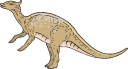
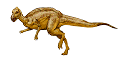
Ornithopod Dinosaurs
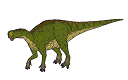
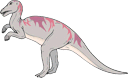
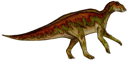
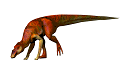
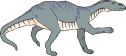
The Ornithopoda (meaning "bird feet")
are an infraorder of herbivorous (plant-eating) dinosaurs.
Early members of this infraorder were small bipedal (walking on two legs)
running animals.
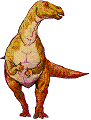
Later Ornithopods were often much larger and at least partially
quadrupedal (walking on
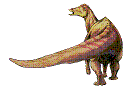
four legs). As a group they were very successful, especially the
duck-bills (Hadrosaurs), it seems principally as a result their
evolution of sophisticated chewing apparatus.
The name Ornithopoda, refers to the animals feet, which in
later species were three-toed (earlier species often had four toes),
and outwardly tended to resemble those of birds (although the
Ornithopoda are not closely related to birds).
Ornithopods first appeared during the
early
Jurassic period,
perhaps around 200 million years ago,
and survived until the
end of the
Cretaceous period.
Ornithopods were among the dinosaurs
which died out during the
mass extinction
of 65 million years ago.
The Ornithopoda infraorder, together with the infraorders of
Ceratopsia ("horned faces")
and
Pachycephalosauria ("thick-headed lizards")
form the the suborder Cerapoda of the
Ornithischian
dinosaurs.


Ornithopod Dinosaur Timeline:
Ornithopods dinosaurs first appeared during the early Jurassic, about 200 million years ago, and survived until the end of the Cretaceous period, about 65 million years ago

Types of Ornithopod Dinosaurs
Here is a list of some Ornithopod dinosaurs:

Related Information & Resources
See Also

Ornithopod Dinosaur Books Here are some books from Amazon.com:
Disclosure: Products details and descriptions provided by Amazon.com. Our company may receive a payment if you purchase products from them after following a link from this website.
Indiana University Press Released: 2006-11-14 Hardcover (384 pages)
 | List Price: $49.95* Lowest New Price: $35.83* Lowest Used Price: $21.99* Usually ships in 24 hours* *(As of 09:09 Pacific 4 Feb 2012 More Info)
Click Here | Product Description:
Horns and Beaks completes Ken Carpenter's series on the major dinosaur types. As with his volumes on armored, carnivorous, and sauropodomorph dinosaurs, this book collects original and new information, reflecting the latest discoveries and research on these two groups of animals. The Ornithopods include Iguanodon, one of the first dinosaurs ever discovered and analyzed, and perhaps the most common and best-documented group, the hadrosaurs or "duckbilled dinosaurs." The Ceratopsians include Triceratops, known for its distinctive three-horned skull and protective collar. Contributors are Michael K. Brett-Surman, Kathleen Brill, Kenneth Carpenter, Benjamin S. Creisler, Tony DiCroce, Andrew A. Farke, Peter M. Galton, David Gilpin, Thomas M. Lehman, Nate L. Murphy, Christopher J. Ott, Gregory S. Paul, Xabier Pereda Suberbiola, Albert Prieto-Marquez, Bruce Rothschild, José Ignacio Ruiz-Omeñaca, Darren H. Tanke, Mark Thompson, David Trexler, and Jonathan R. Wagner. |
|
By David B. Weishampel
Springer Paperback
 | List Price: $38.00* Lowest New Price: $38.00* Temporarily out of stock. Order now and we'll deliver when available. We'll e-mail you with an estimated delivery date as soon as we have more information. Your credit card will not be charged until we ship the item.* *(As of 09:09 Pacific 4 Feb 2012 More Info)
Click Here |
|
Aud Publishing Released: 2011-10-20 Paperback (68 pages)
 | List Price: $40.00* Lowest New Price: $39.95* Lowest Used Price: $39.34* Usually ships in 24 hours* *(As of 09:09 Pacific 4 Feb 2012 More Info)
Click Here | Product Description: Please note that the content of this book primarily consists of articles available from Wikipedia or other free sources online. Koreanosaurus (meaning "Korean lizard") is a genus of ornithopod dinosaur. In May 2003 three fossils of Koreanosaurus were found in the Late Cretaceous-age Seonso Conglomerate from the southern coast of the Bi-bong Dinosaur Fossil Findspot, Boseong, Korean Peninsula: the holotype KDRC-BB2, a partial skeleton lacking the skull, and the paratypes KDRC-BB1 and KDRC-BB3. The type species is Koreanosaurus boseongensis, after its discovery locality (Boseong site 5). The type species was initially named and described in a master's thesis by Lee Dae-Gil in 2008,, and was officially published by Min Huh, Dae-Gil Lee, Jung-Kyun Kim, Jong-Deock Lim and Pascal Godefroit in 2011. |
|
By Source: Wikia
Books LLC, Wiki Series Paperback (36 pages)
 | List Price: $14.14* Lowest New Price: $14.13* Lowest Used Price: $15.60* Usually ships in 24 hours* *(As of 09:09 Pacific 4 Feb 2012 More Info)
Click Here | Product Description: This book consists of articles from Wikia. Pages: 34. Chapters: Carnosaur Animals, Dromaeosaur Animals, Ornithopod Animals, Sauropodomorpha Animals, Synapsids, Tyrannosaur Animals, Allosaurus, Eustreptospondylus, Giganotosaurus, Polar Allosaur, Albertosaurus, Allosaurus, Anatotitan, Ankylosaur, Ankylosaurus, Apatosaurus, Argentinosaurus, Brachiosaurus, Coelophysis, Deinonychus, Dimetrodon, Diplodocus, Dromaeosaurus, Dryosaurus, Euparkeria, Eustreptospondylus, Giganotosaurus, Iguanodon, Incisivosaurus, Leaellynasaura, Liliensternus, Liopleurodon, Macrogryphosaurus, Mei long, Microraptor, Mononykus, Muttaburrasaurus, Ophthalmosaurus, Ornitholestes, Ornithomimus, Othnielia, Parasaurolophus, Plateosaurus, Polacanthus, Polar Allosaur, Protoceratops, Pteranodon, Quetzalcoatlus, Stegosaurus, Tarbosaurus, Therizinosaurus, Torosaurus, Triceratops, Troodon, Tyrannosaurus rex, Utahraptor, Velociraptor, Deinonychus, Dromaeosaurus, Microraptor, Utahraptor, Velociraptor, Dryosaurus, Iguanodon, Leaellynasaura, Muttaburrasaurus, Othnielia, Parasaurolophus, Apatosaurus, Argentinosaurus, Brachiosaurus, Diplodocus, Plateosaurus, Sauropodomorpha, Dimetrodon, Edaphosaurus, Pelycosauria, Synapsida, Albertosaurus, Tarbosaurus, Tyrannosaurus rex. Excerpt: Allosaurus is the top predator of the Jurassic period. While most specimens grew up to 9.5 meters long, the largest specimen (formerly identified as Epanterias) grew to 12.1 meters long, making it the biggest Jurassic predator on the land. An individual named Big Al was just a sub-adult when it died, yet it had 19 injuries. Allosaurus had distinctive crests in front of his eyes for display. They were probably pack hunters and used their numbers to catch larger animals such as Apatosaurus and Diplodocus. Proof of this was shown in the Cleveland Lloyd-Quarry with 75% of the bones belonged to Allosaurus. Though, not everyone agrees and think that like modern reptiles, it showed aggression to each other. The name Allosaurus (al-o-soar-us)... |
|
By Beatriz Scaglia
Webster's Digital Services Paperback (274 pages)
 | List Price: $27.75* Lowest New Price: $19.75* Lowest Used Price: $19.44* Usually ships in 1 to 3 weeks* *(As of 09:09 Pacific 4 Feb 2012 More Info)
Click Here | Product Description: Dominant for over 160 million years during the Triassic Period through the Cretaceous Period, Dinosaurs were a diverse and varied grouping of animals, including over 9,000 bird species. Dinosaur fossils have been found on every continent and paleontologists and paleobiologists continue to gather information on the different species. Some were herbivores, others carnivorous, some bipedal, others quadrupedal and other had wings to fly. This book explores the Ornithopod, Ceratopsian, Pachycephalosaur and Thyreophoran dinosaurs classified by largest and smallest size categories. Project Webster represents a new publishing paradigm, allowing disparate content sources to be curated into cohesive, relevant, and informative books. To date, this content has been curated from Wikipedia articles and images under Creative Commons licensing, although as Project Webster continues to increase in scope and dimension, more licensed and public domain content is being added. We believe books such as this represent a new and exciting lexicon in the sharing of human knowledge. |
|
By Thom Holmes
Enslow Publishers, Incorporated Hardcover
| |
|
Discuss This Page
Linking to This Page
We do hope that you find this site useful.
We welcome people linking to this website, or citing us in their school and educational projects
(remember in school projects and papers, you should always cite your sources).
|
|
|