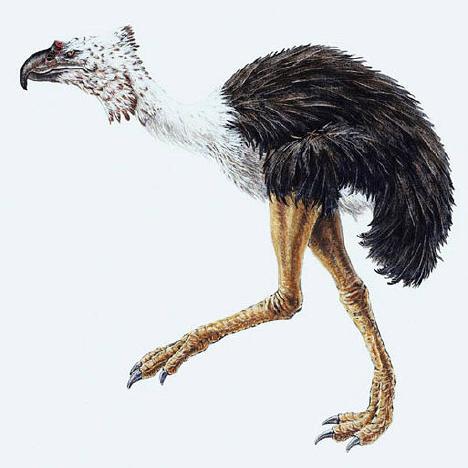
The Phorusrhacids (which means "rag bearers"), popularly known
as "terror birds" were large carnivorous flightless birds
that were native to South America - although some species did
manage to establish themselves in North America after the
Isthmus of Panama land bridge arose about 3 million years ago.
Phorusrhacids first appeared in the Paleocene epoch, about
62 million years ago, and survived until the late Pliocene,
about 2 million years ago.
Many Phorusrhacids were quite small, about to 2 to 3 feet (0.6 to 0.9 meters)
tall, but the largest species were enormous standing 10 feet (3 meters)
tall. The larger species were almost certainly fast runners, and might have been
able to reach speeds of as much as 30 mph (48 km/h).
Phorusrhacids are believed to have generally had beaks with a hooked-curve,
similar to that of an eagle, and additionally their feet may have had sharp claws.
Generally speaking, most Phorusrhacids had shorty, stubby and effectively useless
wings, however the wings of one genus, Titanis, seem to have a joint-like
structure, digits that could flex to some degree (unlike the fused digits of most birds),
and may even have ended in a clawed finger.
Disclosure: Products details and descriptions provided by Amazon.com. Our company may receive a payment if you purchase products from them after following a link from this website.
Product Description: Coastal exposures of the Santa Cruz Formation in southern Patagonia have been a fertile ground for recovery of Early Miocene vertebrates for more than 100 years. This volume presents a comprehensive compilation of important mammalian groups which continue to thrive today. It includes the most recent fossil finds as well as important new interpretations based on 10 years of fieldwork by the authors. A key focus is placed on the paleoclimate and paleoenvironment during the time of deposition in the Middle Miocene Climatic Optimum (MMCO) between 20 and 15 million years ago. The authors present the first reconstruction of what climatic conditions were like and present important new evidence of the geochronological age, habits and community structures of fossil bird and mammal species. Academic researchers and graduate students in paleontology, paleobiology, paleoecology, stratigraphy, climatology and geochronology will find this a valuable source of information about this fascinating geological formation.
Over millions of years, Australia’s unique biodiversity has produced a large cabinet of curiosities. Among the weirder members of this group were the Mihirungs, members of the now extinct family Dromornithidae. Made up of several genera of flightless birds—among them one of the very largest birds that ever lived—the dromornithids ranged from 60-kilogram beasts, 1.5 meters tall, to giants twice that size, weighing nearly half a metric ton. They were, by orders of magnitude, the largest "geese" that ever lived. One species was comparable in size to the Ele-phantbird of Madagascar and the Giant Moa of New Zealand. This book is the first major study of this unique and highly diverse group. It aims to present as complete a synthesis as possible of current information about this fascinating family of birds.
Product Description: An exploration of all that is known about the origin of birds and of avian flight. It draws on fossil evidence and studies of the structure and biochemistry of living birds to present knowledge and data on avian evolution and to propose a new model of this evolutionary process.
Why Elephants Have Big Ears is the result of one man's lifelong quest to understand why the creatures of the earth appear and act as they do. In a wry manner and personal tone, Chris Lavers explores and solves some of nature's most challenging evolutionary mysteries, such as why birds are small and plentiful, why rivers and lakes are dominated by the few remaining large reptiles, why most of the large land-dwellers are mammals, and many more.
Product Description: The present book is the first detailed review of the Paleogene avian fossil record on a worldwide scale. Numerous well-preserved fossil bird remains from this geological period, which covers the time span from the end of the Mesozoic era to the beginning of the Miocene, have been described in the past two decades. Some of these not only provide information on morphological transformations in the evolutionary history of the extant avian taxa, but are also of great significance for an understanding of their historical biogeography. Others represent extinct taxa which sometimes show a bizarre morphology not found in modern birds, such as the giant pseudo-toothed birds which reached wingspans up to six meters. The reader is introduced to basic morphological features of the various groups which, as far as possible, are placed into a phylogenetic context in the light of current hypotheses on the interrelationships of extant birds. In a concluding chapter the biogeographical significance of Paleogene fossil birds and possible reasons for faunal changes during the Paleogene are detailed. As such, the book not only aims at providing an overview for specialists, but may also help students of other fields of vertebrate paleontology to better understand Paleogene ecosystems.
Product Description: Modern birds (Neornithes) are represented by two big lineages, the Palaeognathae (Tinamiformes + Ratitae) and the Neognathae [Galloanserae + Neoaves (Metaves + Coronoaves)]. Both clades sum approximately 10,000 species of which 60% are Passeriformes (the most diverse clade of terrestrial vertebrates). A comparison between the past and the present reveals a complex and hallmarked evolutionary and biogeographic history which would have begun over 65 million years ago. For South America (SA) this includes: (1) the presence of taxa with uncertain affinities and the absence of Passeriformes during the Paleogene; (2) a progressive and accelerated increase of the species starting at the Neogene (Miocene); (3) important extinct lineages (e.g. Phorusrhacidae, Teratornithidae) that migrate to North America after the rising of the Panamá isthmus; (4) groups with major diversification in the Neogene that survives nowadays represented by scarce species endemic of SA (Cariamidae) or that inhabits mainly in the southern hemisphere (Anhingidae); (5) very diverse living groups with scarce (e.g., Passeriformes) or none (e.g., Apodiformes) fossil record in SA, which stem-groups are registered in Europe. Apparently, the changes in diversity of the south American Neornithes have been the result of successive radiation, biogeographic connections with North America and in a minor scale, some extinctions. The opening of the Drake´s passage and the occurrence of the circumpolar Antarctic flow are not sufficient causes to explain the highly disparity between the weddelians penguins (Sphenisciformes) of Antartica and those of the patagonian Atlantic Ocean.
Discuss This Page
Please feel free to post your comments using Facebook comment box (if you have a Facebook account), or Disqus comment box.
We do hope that you find this site useful.
We welcome people linking to this website, or citing us in their school and educational projects
(remember in school projects and papers, you should always cite your sources).
In Association With Amazon.com Answers 2000 Limited is a participant in the Amazon Services LLC Associates Program, an affiliate advertising program designed to provide a means for sites to earn advertising fees by advertising and linking to Amazon.com.
In Assocation With AllPosters.com
CERTAIN CONTENT THAT APPEARS ON THIS SITE COMES FROM AMAZON SERVICES LLC. THIS CONTENT IS PROVIDED 'AS IS' AND IS SUBJECT TO CHANGE OR REMOVAL AT ANY TIME.
Disclosure:
Our company's websites' content (including this website's content) includes advertisements for
our own company's websites, products, and services,
and for other organization's websites, products, and services.
In the case of links to other organization's websites,
our company may receive a payment, (1) if you purchase products or services,
or (2) if you sign-up for third party offers, after following links from this website.
Unless specifically otherwise stated, information about other organization's products and services,
is based on information provided by that organization,
the product/service vendor, and/or publicly available information - and should
not be taken to mean that we have used the product/service in question.
Additionally, our company's websites contain some adverts which we are paid
to display, but whose content is not selected by us, such as Google AdSense ads. For more
detailed information, please see Advertising/Endorsements Disclosures
Our sites use cookies, some of which may already be set on your computer. Use of our site constitutes consent for this. For details, please see Privacy.