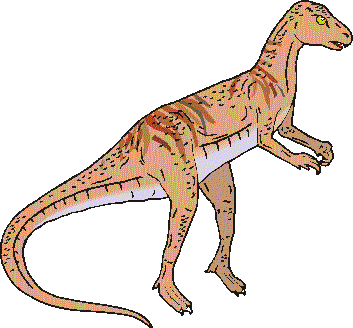
Heterodontosaurus was a small herbivore (plant-eater), only 3 feet (90 centimeters)
long. It lived in the early Jurassic period,
in
South Africa, roughly 205 million years ago.
Its name (which means "varied toothed lizard") stems from its three kinds of
teeth. Its teeth are unusual because reptiles and dinosaurs usually only
have a single kind of teeth. At the frront of Heterodontosaurus' jaw
were small teeth using for chopping leaves and other plant fibers, these
were followed by large tusks which may jhave been used for sexual displays,
and at the back of the jaw were tall square teeth which were adapted for
chewing.
An additional adaption for chewing was cheeks:
Heterodontosaurus was also one of the first kinds of dinosaurs to have developed
cheeks to keep the food in its mouth.
Heterodontosaurus' hands were also interesting. Each hand contained five
fingers, two of which were opposable "thumbs" allowing the
creature to grasp its food.
"Heterodontosaurus" means "varied toothed lizard".
Heterodontosaurus was a member of the Ornithischia ("bird-hipped") order of dinosaurs. What this means, is that although Heterodontosaurus was not closely related to birds, it did have similarly shaped pelvic bones.
Heterodontosaurus lived about 205 million years ago, during the late Jurassic period.
CERTAIN CONTENT THAT APPEARS ON THIS SITE COMES FROM AMAZON SERVICES LLC. THIS CONTENT IS PROVIDED 'AS IS' AND IS SUBJECT TO CHANGE OR REMOVAL AT ANY TIME. CERTAIN CONTENT THAT APPEARS ON THIS SITE,COMES FROM AMAZON EU S.à r.l. THIS CONTENT IS PROVIDED 'AS IS' AND IS SUBJECT TO CHANGE OR REMOVAL AT ANY TIME.
In Association With Amazon.com Answers 2000 Limited is a participant in the Amazon Services LLC Associates Program, an affiliate advertising program designed to provide a means for sites to earn advertising fees by advertising and linking to Amazon.com. In Association With Amazon.co.uk Answers 2000 Limited is a participant in the Amazon EU Associates Programme, an affiliate advertising programme designed to provide a means for sites to earn advertising fees by advertising and linking to Amazon.co.uk. As an Amazon Associate, our company earns from qualifying purchases. Amazon, the Amazon logo, Endless, and the Endless logo are trademarks of Amazon.com, Inc. or its affiliates.
Disclosure:
Our company's websites' content (including this website's content) includes advertisements for
our own company's websites, products, and services,
and for other organization's websites, products, and services.
In the case of links to other organization's websites,
our company may receive a payment, (1) if you purchase products or services,
or (2) if you sign-up for third party offers, after following links from this website.
Unless specifically otherwise stated, information about other organization's products and services,
is based on information provided by that organization,
the product/service vendor, and/or publicly available information - and should
not be taken to mean that we have used the product/service in question.
Additionally, our company's websites contain some adverts which we are paid
to display, but whose content is not selected by us, such as Google AdSense ads. For more
detailed information, please see Advertising/Endorsements Disclosures
Our sites use cookies, some of which may already be set on your computer. Use of our site constitutes consent for this. For details, please see Privacy.
Click privacy for information about our company's privacy, data collection and data retention policies, and your rights.