|
|
|
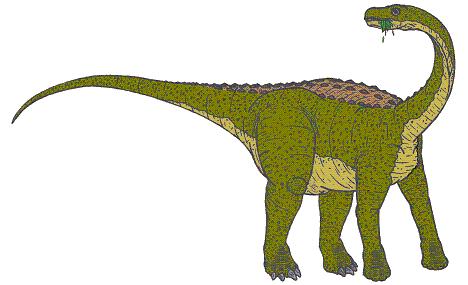
Magyarosaurus
Magyarosaurus was a plant-eater (herbivore) that lived in the area that is today
Romania during the late
Cretaceous period,
between about
71 and 65 million years ago.
Magyarosaurus was quite small for a titanosaur, only about 20 feet (6 meters) long.
When the animal was first discovered,
it was named by Baron Nopsca
in 1915 by Baron Nopsca
as "Titanosaurus dacus"
(Dacia being a reference to ancient Romania),
subsequently,
however,
(in 1932 by Friedrich von Huene),
its name was changed to "Magyarosaurus dacus"
to reflect the fact that both ethnically Hungarian and Romanian people live in the area in which the animal was found
(Magyar is a reference to the Hungarian people).

Magyarosaurus was a herbivore (plant-eater) that lived from 71 to 65 million years ago

Related Information & Resources
See Also

Magyarosaurus Facts
Here is a summary of some of the key facts about Magyarosaurus:
- Magyarosaurus was a genus of dinosaur.
- "Magyarosaurus" means "Magyar lizard" (Magyar is a reference to the Hungarian people). It was originally named (in 1915 by Baron Nopsca) as "Titanosaurus dacus" (Dacia is a reference to ancient Romania), but its name was changed in 1932 (by Friedrich von Huene) to "Magyarosaurus dacus" (to reflect the fact that both ethnically Hungarian and Romanian people live in the area in which the animal was found).
- Magyarosaurus was a member of the Saurischia ("lizard-hipped") order of dinosaurs. What this means, is that although Magyarosaurus was not closely related to lizards, it did have similarly shaped pelvic bones.
- Magyarosaurus was a Sauropod - a member of a group of related large quadrupedal herbivorous (plant-eating) dinosaur with long necks.
- Magyarosaurus lived between about 71 million years ago and 65 million years ago, during the late Cretaceous period.
- Magyarosaurus was one of the dinosaurs which died out during the Cretaceous-Tertiary mass extinction at the end of the Mesozoic Era.
- Magyarosaurus lived in Romania.
- Magyarosaurus was a herbivore (plant-eater).
- Magyarosaurus was about 20 feet (6 meters) long.
Magyarosaurus Pictures and Posters
by AllPosters
Here are some Magyarosaurus pictures and posters:
(Disclosure: Products details and descriptions provided by AllPosters. Our company may receive a payment if you purchase products from them after following a link from this website).
Magyarosaurus Books Here are some books from Amazon.com:
Disclosure: Products details and descriptions provided by Amazon.com. Our company may receive a payment if you purchase products from them after following a link from this website.
By David B. Weishampel
The Johns Hopkins University Press Hardcover (328 pages)
 | List Price: $60.00* Lowest New Price: $31.41* Lowest Used Price: $29.73* Usually ships in 24 hours* *(As of 17:02 Pacific 17 May 2012 More Info)
Click Here | Product Description:
At the end of the time of the dinosaurs, Transylvania was an island in what was to become southeastern Europe. The island's limited resources affected the size and life histories of its animals, resulting in a local dwarfism. For example, sauropods found on the island measured only six meters long, while their cousins elsewhere grew up to five times larger. Here, David B. Weishampel and Coralia-Maria Jianu present unique evolutionary interpretations of this phenomenon. The authors bring together the latest information on the fauna, flora, geology, and paleogeography of the region, casting these ancient reptiles in their phylogenetic, paleoecological, and evolutionary contexts. What the authors find is that Transylvanian dinosaurs experienced a range of unpredictable successes as they evolved. Woven throughout the detailed history and science of these diminutive dinosaurs is the fascinating story of the man who first discovered them, the mysterious twentieth-century paleontologist Franz Baron Nopcsa, whose name is synonymous with Transylvanian dinosaurs. Hailed by some as the father of paleobiology, it was Nopcsa alone who understood the importance of the dinosaur discoveries in Transylvania; their story cannot be told without recounting his. Transylvanian Dinosaurs strikes an engaging balance between biography and scientific treatise and is sure to capture the imagination of professional paleontologists and amateur dinophiles alike. (2011) |
|
University of California Press Hardcover (358 pages)
 | List Price: $70.00* Lowest New Price: $24.53* Lowest Used Price: $40.78* Usually ships in 24 hours* *(As of 17:02 Pacific 17 May 2012 More Info)
Click Here | Product Description:
Sauropod dinosaurs were the largest animals ever to walk the earth, and they represent a substantial portion of vertebrate biomass and biodiversity during the Mesozoic Era. The story of sauropod evolution is told in an extensive fossil record of skeletons and footprints that span the globe and 150 million years of earth history. This generously illustrated volume is the first comprehensive scientific summary of sauropod evolution and paleobiology. The contributors explore sauropod anatomy, detail its variations, and question the myth that life at large size led to evolutionary stagnation and eventual replacement by more "advanced" herbivorous dinosaurs. Chapters address topics such as the evolutionary history and diversity of sauropods; methods for creating three-dimensional reconstructions of their skeletons; questions of sauropod herbivory, tracks, gigantism, locomotion, reproduction, growth rates, and more. This book, together with the recent surge in sauropod discoveries around the world and taxonomic revisions of fragmentary genera, will shed new light on "nature's greatest extravagances." |
|
By Beatriz Scaglia
Webster's Digital Services Paperback (272 pages)
 | List Price: $27.75* Lowest New Price: $19.41* Usually ships in 2 to 3 weeks* *(As of 17:02 Pacific 17 May 2012 More Info)
Click Here | Product Description: Please note that the content of this book primarily consists of articles available from Wikipedia or other free sources online. Dominant for over 160 million years during the Triassic Period through the Cretaceous Period, Dinosaurs were a diverse and varied grouping of animals, including over 9,000 bird species. Dinosaur fossils have been found on every continent and paleontologists and paleobiologists continue to gather information on the different species. Some were herbivores, others carnivorous, some bipedal, others quadrupedal and other had wings to fly. This book explores the Sauropods (Sauropoda) and Theropods (Theropoda) dinosaurs classified by largest and smallest size categories. Project Webster represents a new publishing paradigm, allowing disparate content sources to be curated into cohesive, relevant, and informative books. To date, this content has been curated from Wikipedia articles and images under Creative Commons licensing, although as Project Webster continues to increase in scope and dimension, more licensed and public domain content is being added. We believe books such as this represent a new and exciting lexicon in the sharing of human knowledge. |
|
By Ernst Probst
GRIN Verlag Paperback (480 pages)
 | List Price: $69.90* Lowest New Price: $61.09* Lowest Used Price: $61.56* Usually ships in 2 to 3 weeks* *(As of 17:02 Pacific 17 May 2012 More Info)
Click Here | Product Description: Dokument aus dem Jahr 2010 im Fachbereich Biologie - Evolution, Note: -, - (-), Veranstaltung: -, Sprache: Deutsch, Abstract: Dinosaurier von L bis Z werden in dem gleichnamigen Taschenbuch des Wiesbadener Wissenschaftsautors Ernst Probst vorgestellt. Bei jeder Dinosaurier-Gattung erfährt man, worauf deren wissenschaftlicher Name beruht. Es folgen Angaben über die Größe, das zeitliche und geographische Vorkommen, die systematische Stellung und über die wissenschaftliche Erstbeschreibung. „Dinosaurier von L bis Z“ beschreibt die wichtigsten Gattungen der „schrecklichen Echsen von Labocania bis zu Zupaysaurus. Über „Dinosaurier von A bis K“ informiert ein anderer Band. Ernst Probst hat sich durch zahlreiche populärwissenschaftliche Bücher einen Namen gemacht. Bekannte Werke aus seiner Feder sind: „Deutschland in der Urzeit“, „Rekorde der Urzeit“, „Dinosaurier in Deutschland“ (letzterer Titel zusammen mit Raymund Windolf), „Der Ur-Rhein“, „Der Rhein-Elefant“, „Deutschland im Eiszeitalter“, „Der Mosbacher Löwe“ „Höhlenlöwen“, „Säbelzahnkatzen“, „Der Höhlenbär“, „Monstern auf der Spur“, „Nessie“, „Affenmenschen“ und „Seeungeheuer“. |
|
By Istvan Fozy
Alfadat-Press Unknown Binding (168 pages)
| |
|

Discuss This Page
Linking to This Page
We do hope that you find this site useful.
We welcome people linking to this website, or citing us in their school and educational projects
(remember in school projects and papers, you should always cite your sources).
|
|
|