|
|
|
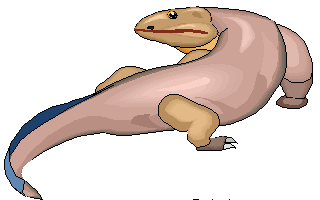
Ichthyostega
Click here for more Ichthyostega Pictures
| Scientific Classification |
|
|
|
|
|
|
Ichthyostega was a genus of early tetrapod that lived in the
late Devonian period between about 367 and 362 million years ago.
It was intermediate between fish and amphibians, but generally
included more amphibian-like features like lungs, and limbs.
Icththyostega was about 5 feet (1.5 meters) long including
a tail with fin rays. Each of
its hind feet had seven digits - the number of digits on
its front feed is not yet certain. It is thought to have
lived mostly on land, and though the smaller juvenile
animals would have found moving on land much easier than the
large and heavy adults.

Ichthyostega was an animal intermediate between fish and amphibians that lived between 367 and 362 million years ago

Related Information & Resources
See Also

Ichthyostega Pictures and Posters
by AllPosters
Here are some Ichthyostega pictures and posters:
(Disclosure: Products details and descriptions provided by AllPosters. Our company may receive a payment if you purchase products from them after following a link from this website).
Ichthyostega Books Here are some books from Amazon.com:
Disclosure: Products details and descriptions provided by Amazon.com. Our company may receive a payment if you purchase products from them after following a link from this website.
By Thomas R. Diehl
Released: 2012-04-14 Kindle Edition (27 pages)
 | | Product Description: Vor etwa 370 Millionen Jahren wagten die ersten Fische den Schritt aufs Land. Fischlurche, Fische mit Beinen, sollten die Grundlage für eine der erfolgreichsten Geschichten des Lebens auf der Erde werden. Und auch wenn vieles noch im Dunkeln liegt, wir wissen inzwischen viel über diese Pioniere und kennen einige von ihnen als Fossilien. Feuchten Fußes begibt sich in die Welt dieser seltsamen Tiere und stellt jene Wesen vor, die den Weg vom Fisch zum Lurch aufzeigen und damit den Anfang der Entwicklung aller Landwirbeltiere, vom Frosch über die Dinosaurier bis zum Menschen und darüber hinaus darstellen. |
|
By Erik Jarvik
Wiley-Blackwell Paperback (212 pages)
 | List Price: $64.95* Lowest New Price: $58.62* Lowest Used Price: $49.80* Usually ships in 24 hours* *(As of 20:29 Pacific 17 May 2012 More Info)
Click Here |
|
By Source: Wikipedia
Books LLC, Reference Series Paperback (30 pages)
 | List Price: $14.14* Lowest New Price: $14.13* Usually ships in 24 hours* *(As of 20:29 Pacific 17 May 2012 More Info)
Click Here | Product Description: Fuente: Wikipedia. Páginas: 28. Capítulos: Acanthodii, Chondrichthyes, Osteichthyes, Placodermi, Tetrapoda, Dunkleosteus, Amniota, Stegocephalia, Ichthyostega, Pederpes, Teleostomi, Materpiscis, Whatcheeria, Elasmobranchii, Acanthostega, Ischnacanthiformes, Greererpeton, Climatius, Climatiiformes, Crassigyrinus, Caerorhachis, Megalocephalus, Ptychodus, Westlothiana, Dinichthyidae, Arthrodira, Hynerpeton, Titanichthys, Colosteidae, Coccosteina, Coccosteus, Ossinodus, Dinichthyloidea, Whatcheeriidae, Pholidogaster, Dinichthys, Elginerpeton, Colosteus, Brachythoraci, Pterichthyodes. Extracto: Los placodermos (Placodermi, del griego, πλάξ=placa, δέρμα=piel, "piel de placas") son una clase extinta de peces primitivos. Fueron los primeros gnatostomados, es decir, fueron los primeros vertebrados con mandíbulas. Aparecieron a finales del Silúrico (hace unos 416 millones de años) y desaparecieron a finales del Devónico (hace unos 359 millones de años), aunque no está muy claro si sobrevivieron hasta el Carbonífero inferior. Los placodermos eran peces acorazados, y su origen y su relación con la evolución de los condrictios (el grupo de peces cartilaginosos al que pertenecen los tiburones, las rayas y las quimeras) es un enigma para los científicos. Habitaban una gran diversidad de ambientes: marinos, deltaicos, de albufera y de agua dulce. En el yacimiento paleontológico de Gogo, en Australia, de edad Devónico Superior, es donde se encuentra la mayor diversidad de estos organismos, ya que se han hallado restos de más de 20 especies, la mayoría de ellas pertenecientes a géneros monoespecíficos. Placas craneales de Dunkleosteus (Arthrodira). Se pueden apreciar las características de los dientes, y la placas que rodean al ojo. Fósil de Bothriolepis panderi, un placodermo del orden Antiarchi. Se puede apreciar la fosa central. Fósil de Lunaspis broili, un placodermo del orden Petalichthyida. Reconstrucción de Phyllolepis, un placodermo del orden Phyllolepida, enterrándose en... |
|
By Sébastien Steyer
Indiana University Press Released: 2012-06-01 Paperback (200 pages)
 | List Price: $35.00* Lowest New Price: $22.64* Not yet published* *(As of 20:29 Pacific 17 May 2012 More Info)
Click Here | Product Description:
This beautiful volume introduces the incredible animals that populated the planet before the Age of the Dinosaurs. Readers voyage to a time, beginning about 370 million years ago, when the first four-footed vertebrates appeared, and ending 200 million years later at the moment when the dinosaurs begin their ascent. During this time, vertebrates emerge from the sea and there appears a parade of animals, each more astonishing than the last. On this expedition, we learn how paleontologists become detectives to understand the history of life and we discover that many widely held ideas about the evolution of species are completely false. Earth before the Dinosaurs is an entertaining and informative guide to an astonishing and little-known world. |
|
By Carl Zimmer
Free Press Released: 1999-09-08 Paperback (304 pages)
 | List Price: $15.00* Lowest New Price: $8.51* Lowest Used Price: $3.81* Usually ships in 24 hours* *(As of 20:29 Pacific 17 May 2012 More Info)
Click Here | Product Description: Everybody Out of the Pond At the Water's Edge will change the way you think about your place in the world. The awesome journey of life's transformation from the first microbes 4 billion years ago to Homo sapiens today is an epic that we are only now beginning to grasp. Magnificent and bizarre, it is the story of how we got here, what we left behind, and what we brought with us. We all know about evolution, but it still seems absurd that our ancestors were fish. Darwin's idea of natural selection was the key to solving generation-to-generation evolution -- microevolution -- but it could only point us toward a complete explanation, still to come, of the engines of macroevolution, the transformation of body shapes across millions of years. Now, drawing on the latest fossil discoveries and breakthrough scientific analysis, Carl Zimmer reveals how macroevolution works. Escorting us along the trail of discovery up to the current dramatic research in paleontology, ecology, genetics, and embryology, Zimmer shows how scientists today are unveiling the secrets of life that biologists struggled with two centuries ago. In this book, you will find a dazzling, brash literary talent and a rigorous scientific sensibility gracefully brought together. Carl Zimmer provides a comprehensive, lucid, and authoritative answer to the mystery of how nature actually made itself. |
|
By Michel Laurin
University of California Press Hardcover (216 pages)
 | List Price: $34.95* Lowest New Price: $23.94* Lowest Used Price: $22.34* Usually ships in 24 hours* *(As of 20:29 Pacific 17 May 2012 More Info)
Click Here | Product Description:
More than three hundred million years ago--a relatively recent date in the two billion years since life first appeared--vertebrate animals first ventured onto land. This usefully illustrated book describes how some finned vertebrates acquired limbs, giving rise to more than 25,000 extant tetrapod species. Michel Laurin uses paleontological, geological, physiological, and comparative anatomical data to describe this monumental event. He summarizes key concepts of modern paleontological research, including biological nomenclature, paleontological and molecular dating, and the methods used to infer phylogeny and character evolution. Along with a discussion of the evolutionary pressures that may have led vertebrates onto dry land, the book also shows how extant vertebrates yield clues about the conquest of land and how scientists uncover evolutionary history. |
|
By Jennifer A. Clack
Indiana University Press Hardcover (400 pages)
 | List Price: $49.95* Lowest New Price: $131.08* Lowest Used Price: $42.44* *(As of 20:29 Pacific 17 May 2012 More Info)
Click Here | Product Description:
Around 370 million years ago, a distant relative of a modern lungfish began the most exciting adventure the world had ever seen: it emerged from the water and laid claim to the land. Over the next 70 million years, this tentative beachhead became a worldwide colonization by an ever-increasing variety of four-limbed life. These first "tetrapods" are the ancestors of all vertebrate life on land. Gaining Ground tells the rich and complex story of their emergence and evolution. Beginning with their closest relatives, the lobefin fishes such as lungfishes and coelacanths, Jennifer A. Clack defines the characteristics of tetrapods, describing their anatomy and explaining how they are related to other vertebrates. Clack looks at the Devonian environment in which tetrapods evolved, describes the known species, and explores the order and timing of anatomical changes that occurred during the fish-to-tetrapod transition. She reports that older ideas about the transition are being overturned by recent discoveries and new ideas about evolutionary change. Following the story through the Carboniferous period, she shows how the evolution of terrestrial characters occurred several times, convergently, among different groups. |
|
By Hannah Bonner
National Geographic Children's Books Released: 2009-09-08 Paperback (48 pages)
 | List Price: $7.95* Lowest New Price: $3.35* Lowest Used Price: $3.34* Usually ships in 24 hours* *(As of 20:29 Pacific 17 May 2012 More Info)
Click Here | Product Description: Take a fun, fact-filled trip back to Earth as it was 430 million years ago. Then, watch as continents drift and oceans take shape. Watch out (!) as fish get toothier, plants stretch skywards and bugs get bigger. Soon fish get feet and four-legged creatures stalk the planet. Here’s the story of Earth in conversational text, informative illustrations, and humorous cartoons. Complete with time line, pronunciation guide, glossary and index. |
|
University Of Chicago Press Paperback (344 pages)
 | List Price: $47.50* Lowest New Price: $47.18* Lowest Used Price: $38.95* Usually ships in 24 hours* *(As of 20:29 Pacific 17 May 2012 More Info)
Click Here | Product Description:
Long ago, fish fins evolved into the limbs of land vertebrates and tetrapods. During this transition, some elements of the fin were carried over while new features developed. Lizard limbs, bird wings, and human arms and legs are therefore all evolutionary modifications of the original tetrapod limb.
A comprehensive look at the current state of research on fin and limb evolution and development, this volume addresses a wide range of subjects—including growth, structure, maintenance, function, and regeneration. Divided into sections on evolution, development, and transformations, the book begins with a historical introduction to the study of fins and limbs and goes on to consider the evolution of limbs into wings as well as adaptations associated with specialized modes of life, such as digging and burrowing. Fins into Limbs also discusses occasions when evolution appears to have been reversed—in whales, for example, whose front limbs became flippers when they reverted to the water—as well as situations in which limbs are lost, such as in snakes.
With contributions from world-renowned researchers, Fins into Limbs will be a font for further investigations in the changing field of evolutionary developmental biology.
(20070914) |
|
By M. Vecoli & B. Meyer-Berthaud
The Geological Society of London Hardcover (192 pages)
 | List Price: $200.00* Lowest New Price: $187.34* Usually ships in 24 hours* *(As of 20:29 Pacific 17 May 2012 More Info)
Click Here | Product Description: The invasion of the land by plants (terrestrialization) was one of the most significant evolutionary events in the history of life on Earth, and correlates in time with periods of major palaeoenvironmental perturbations. The development of a vegetation cover on the previously barren land surfaces impacted on the global biogeochemical cycles and the geological processes of erosion and sediment transport. The terrestrialization of plants preceded the rise of major new groups of animals, such as insects and tetrapods, the latter numbering some 24 000 living species, including ourselves. Early land-plant evolution also correlates with the most spectacular decline of atmospheric CO2 concentration of Phanerozoic times and with the onset of a protracted period of glacial conditions on Earth. This book includes a selection of papers covering different aspects of the terrestrialization, from palaeobotany to vertebrate palaeontology and geochemistry, promoting a multidisciplinary approach to the understanding of the co-evolution of life and its environments during Early to Mid-Palaeozoic times.The Geological Society of London Founded in 1807, the Geological Society of London is the oldest geological society in the world, and one of the largest publishers in the Earth sciences. The Society publishes a wide range of high-quality peer-reviewed titles for academics and professionals working in the geosciences, and enjoys an enviable international reputation for the quality of its work. The many areas in which we publish in include: -Petroleum geology -Tectonics, structural geology and geodynamics -Stratigraphy, sedimentology and paleontology -Volcanology, magmatic studies and geochemistry -Remote sensing -History of geology -Regional geology guides |
|

Discuss This Page
Linking to This Page
We do hope that you find this site useful.
We welcome people linking to this website, or citing us in their school and educational projects
(remember in school projects and papers, you should always cite your sources).
|
|
|